
The Smart Techie was renamed Siliconindia India Edition starting Feb 2012 to continue the nearly two decade track record of excellence of our US edition.
August - 2008 - issue > Technology
Improving Managed Services with ASL
Sharada Prasadita & Mark Smalley


What is worth noting here is that India is gaining a larger section of the managed IT services market and according to Gartner, six of the top offshore services in the country now hold 2.4 per cent of the IT services market, compared to 1.9 per cent in 2006. Gartner expects the share of these companies to continue growing.
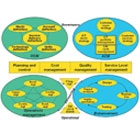
Where CMMi is used to improve the maturity of application development, ITIL is often used for managed services. The majority of IT companies in India are adopting the ITIL framework for both application management services and infrastructure management. However, where application management is included in managed services, ITIL often seems to fall short on acceptance. The new version (V3) of ITIL covers almost every conceivable IT service management topic, but if you are looking for a dedicated framework on application management there is an alternative that can be used as an add-on to ITIL. The Application Service Library (ASL) provides a process framework with many best practices and is particularly meaningful for managing applications as a service. There is a formalized training program with EXIN certification.
IT management, which is currently challenged by having to justify the large proportion of IT spending, mitigating operational and other risks while coping with increasing technical and organizational complexity, and the seemingly never-ending challenge of bridging the gap between IT and the business. ASL contributes to these issues by providing better insight into the costs of application management, reducing risks by improving the reliability of both management processes and operational processes, while also improving alignment with the business by initiating and feeding a strategic dialogue between application management and business information management.




|
|