

3 Lessons From the Rise and Fall of SKS Microfinance
3. Pay For Sustainability, Not for Growth
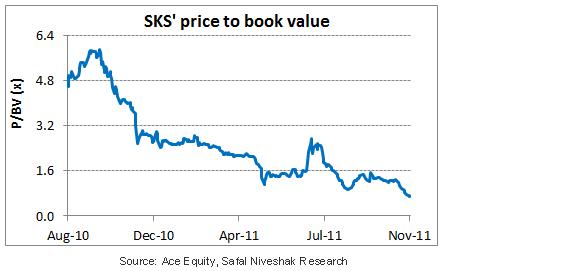
SKS’ IPO was priced expensively, and people were more than willing to pay the price.
The reason – expectations of high growth in the future.
The stock was priced at around 5 times its book value, which was then at a premium, even when compared to some of its more established and more profitable financial sector peers.
As it stands now, forget future growth, investors are not even valuing the stock for the money they’ve invested in the company.
As you can see from the chart below, the stock is currently trading at a price to book value multiple of 0.7 times.
What this simply means is that investors are valuing every  100 invested by them in the company, at just 70.
Charlie Munger, Warren Buffett’s partner at Berkshire Hathaway, once said that if he were giving a test calling for an analyst to value a new dot-com internet company, he would fail anyone who answered the question.
Munger’s simple reason was that investors must not pay for any prediction of future sales or profit growth of a company, simply because the future is unseen.
Sensible investors refuse to pay anything for even the rosiest prediction (of future growth) that has no current or historical foundation. This especially holds true for new businesses and companies like SKS.
The only growth that creates value for shareholders is growth in markets where a firm enjoys a competitive advantage. And microfinance isn’t that sector. It never was.
But who cares when all one sees is listing gains and a business whose future seems brighter than any other business out there?
I believe investors do well when they pay for the sustainability of a business instead if its growth.
I’ll be more than happy investing in a company that I see existing for the next 50 years, even if I see its profits growing at just 8-10 percent per year, than a company that is growing at 50 percent+ levels, and thus has a higher chance of tripping over.


