
 Magazine :
VLSID 2025 Begins with Industry Leaders and Govt Dignitaries
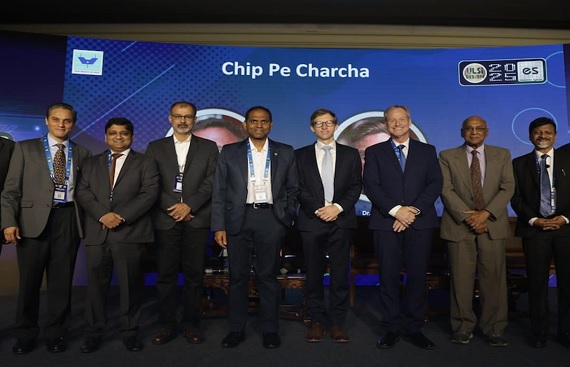
The 38th edition of the International Conference on VLSI Design & 24th International Conference on Embedded Systems, organized by the VLSI Society of India (VSI), was officially inaugurated on 6th January 2025 at The Leela Palace, Bengaluru. The event witnessed the participation of leading semiconductor industry figures and government dignitaries, setting the stage for an exciting exploration of the latest advancements in VLSI and Embedded Systems. The inauguration ceremony kicked off with a grand opening, highlighting the theme 'Silicon Meets AI: Sustainable Innovations in Accelerated Computing, Secure Connectivity & Intelligent Mobility', This theme underscored the crucial role of VLSI and Embedded Systems in shaping the future of transformative technologies such as Artificial Intelligence (AI), Machine Learning (ML), 5G, Internet of Things (IoT), quantum computing, and electric vehicles.
VLSID 2025 reaffirmed its position as a prestigious global event, attracting over 2700 registrants. The conference featured 18 keynote sessions, 32 tutorials, 74 research papers, 5 expert panel discussions, 16 user design sessions, more than 50 exhibits, 13 industry forum sessions, 15 design contest finalists, and 30 industry sponsors. Among the key highlights of the inauguration was the presence of Dr. Chris Miller, Professor at Tufts University and author of the bestselling book Chip War: The Fight for the World’s Most Critical Technology. His insights were shared during a fireside chat session titled ‘Chip-Pe-Charcha’, moderated by Dr. Satya Gupta, President of VSI. The session proved to be a key attraction, delving into the latest global innovations in semiconductors.
One of the session’s key takeaways included discussions around India’s Semiconductor Roadmap, focusing on how the country could position itself as a global leader in semiconductor innovation. This was followed by discussions on cutting-edge research areas such as hardware for machine learning, VLSI for automotive systems, quantum computing, and neuromorphic computing. The session further highlighted the vast opportunities arising from advancements in edge computing, data centers, and compound semiconductors.
Dr. Satya Gupta, President of VSI, noted the significance of VLSID 2025 as a unique convergence of global talent and innovation. He emphasized the importance of collaboration across the semiconductor and AI ecosystems in addressing the challenges of the future. Dr. Gupta also highlighted India’s growing prominence in the global semiconductor landscape, noting that the country’s advancements were being closely observed around the world. Patrick Johnson, Senior Corporate Vice President at Microchip Technology and executive chair of the VLSI Design Conference, echoed this sentiment, pointing out the immense potential of integrating silicon with AI. He further remarked that VLSID 2025 presented an ideal platform to explore how these advancements could revolutionize mobility, connectivity, and computing.
Sandeep Bharathi, Chief Development Officer at Marvell Technology, shared his thoughts on the emerging semiconductor ecosystem, stressing the importance of Artificial Intelligence (AI) and Machine Learning (ML) in accelerating design and manufacturing processes. He explained how AI and ML were not only disrupting the semiconductor design ecosystem but also re-defining its very structure. Bharathi emphasized that these technologies were enabling innovators to push the boundaries of what was possible, setting the stage for a new generation of technological breakthroughs. He expressed his excitement about the opportunity provided by VLSID 2025 to explore these advancements in greater depth.
Hitesh Garg, Vice President and India Managing Director at NXP Semiconductors, highlighted the significance of a strong talent pipeline and a thriving startup ecosystem for the future growth and innovation of the semiconductor industry. Garg pointed out the need for programs that foster industry-academia exchanges and provide mentorship opportunities for students and young professionals. He stressed that such programs were essential to maintaining competitiveness in the global market. He also emphasized the value of cross-learning opportunities provided by VLSID 2025, which brought together industry participants, academia, and the startup ecosystem.
The event not only served as a platform for knowledge sharing but also acted as a crucial networking opportunity for stakeholders from various sectors. By facilitating collaboration between the semiconductor industry, academia, and the startup ecosystem, VLSID 2025 contributed to addressing the emerging challenges and opportunities in the sector. Furthermore, the conference aligned with India’s flagship initiatives such as Digital India, Make in India, and Startup India, reinforcing the nation’s commitment to building a sustainable and innovative digital economy. The exhibition area, which hosted 58 of the best ESDM organizations, also saw a significant footfall, further cementing the importance of the event in the global semiconductor ecosystem.
Read More News :
.jpg "Top Companies of the Year")