Magazine :
ISRO to launch Aditya-L1 spacecraft to study the Sun on Sep 2 morning
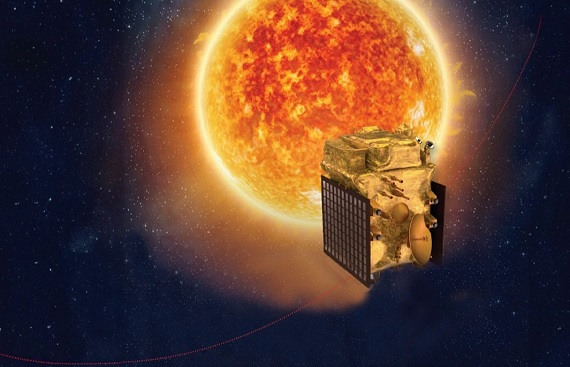
After the Moon, it is the Sun for the Indian Space Agency. Days after landing India on the Moon safely, the Indian Space Research Organisation (ISRO) will be launching the country’s first space-based observatory called Aditya-L1 to study the Sun at 11.50 a.m. on September 2. The Indian Space Agency has invited public to register in order to view the proposed launch from the gallery at the Sriharikota space port in Andhra Pradesh. The Aditya-L1 – named after the Sun God in Hindu mythology - will be carried by the Indian rocket Polar Satellite Launch Vehicle-XL variant (PSLV-XL), the ISRO said.
Initially, Aditya-L1 will be ejected in a low earth orbit (LEO). Then the orbit will be elliptical. As the spacecraft travels towards L1, it will exit the earth’s gravitational Sphere of Influence (SOI). After exit from SOI, the cruise phase will start and subsequently, the spacecraft will be injected into a large halo orbit around L1. The total travel time from launch to L1 would take about four months for Aditya-L1 and the distance will be about 1.5 million km from the Earth. The distance between the Earth and the Moon is about 3,84,000 km. "A satellite placed in the halo orbit around the L1 point has the major advantage of continuously viewing the Sun without any occultation/eclipses. This will provide a greater advantage of observing the solar activities and its effect on space weather in real-time,” the ISRO said.
According to the ISRO, the spacecraft carries seven payloads to observe the photosphere, chromosphere, and the outermost layers of the Sun (the corona) using electromagnetic and particle and magnetic field detectors. "Using the special vantage point L1, four payloads directly view the Sun and the remaining three payloads carry out in-situ studies of particles and fields at the Lagrange point L1, thus providing important scientific studies of the propagation effect of solar dynamics in the interplanetary medium," it said. Aditya-L1’s seven payloads are expected to provide the most crucial information to understand the problem of coronal heating, coronal mass ejection, pre-flare and flare activities and their characteristics, dynamics of space weather, propagation of particles and fields and others, the Indian space agency said.
The ISRO said the major science objectives of the Aditya-L1 mission are the study of solar upper atmospheric (chromosphere and corona) dynamics, study of chromospheric and coronal heating, physics of the partially ionized plasma, and initiation of the coronal mass ejections and flares. It will also observe the in-situ particle and plasma environment, providing data for the study of particle dynamics from the Sun. Other objectives are the physics of solar corona and its heating mechanism, the diagnostics of the coronal and coronal loops plasma: Temperature, velocity and density, development, dynamics and origin of Coronal Mass Ejections (CME), to identify the sequence of processes that occur at multiple layers (chromosphere, base and extended corona) which eventually leads to solar eruptive events, magnetic field topology and magnetic field measurements in the solar corona, and the drivers for space weather (origin, composition and dynamics of solar wind).
The Indian space agency said that the Sun estimated to be 4.5 billion years old is a hot glowing ball of hydrogen and helium gases and is the source of energy for the solar system. "The gravity of the sun holds all the objects of the solar system together. At the central region of the sun, known as ‘core’, the temperature can reach as high as 15 million degree Celsius," it said. At this temperature, a process called nuclear fusion takes place in the core, which powers the sun. The visible surface of the sun known as the photosphere is relatively cool and has a temperature of about 5,500 degree Celsius, the ISRO said. The sun is the nearest star and, therefore can be studied in much more detail as compared to other stars. By studying the sun, we can learn much more about stars in our Milky Way as well as about stars in various other galaxies, the ISRO said.
Read More News :
Reliance invested over $150 bn in the last 10 years, most by any corporate house in India
26th Bengaluru Tech Summit to begin from Nov 29; tech leaders from 50 countries to participate