

India Joins Elite Club with Human-Rated Cryogenic Engine
India has joined a select group of six countries comprising the US, France, Russia, China, and Japan that have successfully achieved indigenous cryogenic capability, announced ISRO Chairman Dr. V. Narayanan on Monday.
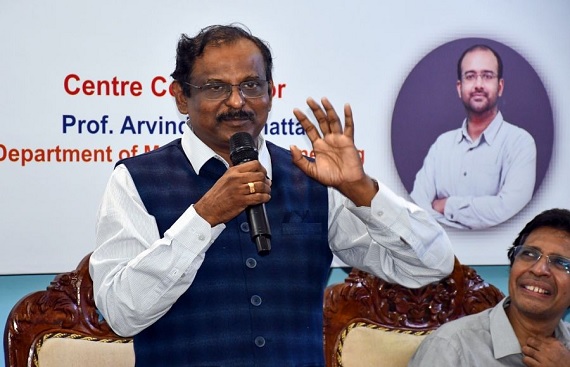
Delivering the inaugural address for a research center at IIT Madras, Narayanan pointed out the progress of India's space program, specifically the human certification of ISRO's CE20 cryogenic engine for the Gaganyaan mission.
"The Cryogenic Engine technology was once denied to India, but now we have built three such engines, the last one being human-rated. This milestone puts us in the league of the very few countries who possess this capability," Narayanan said.
He also emphasized ISRO's world records in cryogenic technology, such as success in the third attempt, the engine test-to-flight conversion in a record 28 months compared to 42 months to 18 years for other countries and testing in merely 34 days, a record unmatched anywhere in the world.
Also, Narayanan called upon IIT Madras to have ambitious objectives, such as going for Nobel Prizes.
In parallel, ISRO's Vikram Sarabhai Space Centre (VSSC), in association with Semiconductor Laboratory (SCL), Chandigarh, has designed two indigenous 32-bit microprocessors VIKRAM3201 and KALPANA3201 specifically for space use.
VIKRAM3201, the first completely "Make-in-India" 32-bit microprocessor of India, has been developed to meet the harsh launch vehicle environmental conditions. It is produced at SCL's 180nm CMOS semiconductor fab. It is an upgraded version of the VIKRAM1601, which has been operational since 2009.
KALPANA3201, a 32-bit SPARC V8 RISC microprocessor, is based on the IEEE 1754 Instruction Set Architecture and has been made compatible with open-source software toolsets, as well as an in-house simulator and IDE.
These processors are a major milestone toward India's indigenization in key space technologies, cementing ISRO's resolve to innovation and indigenous development.


