
 Magazine :
America's loss could be India's gain
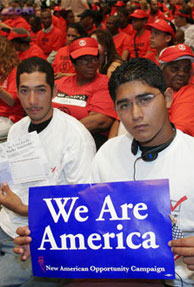
Bangalore: Rules of immigration have been a matter of controversy of late. Because of the economic, social, and political aspects of immigration there has been a hue and cry over issues like ethnicity, economic benefits, jobs for non-immigrants, settlement patterns and so on. Adding to this controversy, some American political leaders are trying to keep the bright and skilled immigrants out of the country, as they believe that skilled immigrants take American jobs away. Is it so? In reality, the truth is the complete opposite to this belief.
According to a CII study, nearly two-third of Indian firms, which have operations in the U.S, has generated 2,585 jobs in America in the last six years due to their acquisition of U.S firms. The survey represents sectors such as pharma, telecom, healthcare and energy among others. These Indian companies employ more than 60,000 people across 40 states of the U.S and an overwhelming majority of employees in these firms are American citizens.
A majority of startups in the Silicon Valley are started by the skilled immigrants and they create jobs. Indian businesses have widely invested in the U.S. and have sustained and generated thousands of direct and indirect jobs. Between 1995 and 2005, 25 percent of Silicon Valley's startups employed nearly 4,50,000 people. According to a report titled, Intellectual Property, the Immigration Backlog, and a Reverse Brain-Drain, co-authored by Vivek Wadhwa, these companies generated $52 billion in revenue in 2006.
But adding to recent debates about limits on H-1B visas for skilled immigrants, many of these foreign workers are returning home after completing degrees in the U.S. Moreover, over half-a-million highly-educated and skilled immigrants are stuck with temporary, non-immigrant work visas like the H-1B, which don't allow them to start a company or even change jobs. They could be required to leave the U.S. immediately, if their employer lays them off. As a result of this, these immigrants have no choice but to return home rather than live in constant fear and uncertainty about their careers.
According to the Asian American Center for Advancing Justice (Center for Advancing Justice), the H-1B visa program has a positive impact on the maintaining America's competitive edge in the global economy. The center has urged the House Subcommittee on Immigration Policy and Enforcement last month to consider legislative changes that will protect H-1B workers. "The H-1B visa program is an important tool in ensuring that America has sufficient numbers of skilled, specialized workers to keep our country competitive," said Karen K. Narasaki, president and executive director of the Asian American Justice Center. "H-1B workers are particularly important during this time of economic recovery", he added.
But unfortunately, the United States doesn't seem to understand that, and the "American immigration officials are doing everything they can to make life miserable for immigrants who want to make the U.S. more competitive and create U.S. jobs". This could prove beneficial to countries like India as tighter rules will force the bright minds to stay and innovate in the country. Isn't Silicon Valley's innovation hub landing in serious peril by losing some of its brightest minds due to stringent U.S. immigration policy?


.jpg "Top Companies of the Year")