 Processing .....please wait..
  The article has been forwarded....
Train to Real India: On Road to Entrepreneurship
Monday, 09 January 2012, 15:41 IST


 40-120. We want to convert these job seekers into job creators," Dixit said.
An Indian Railways train was booked for the Dec 24-Jan 8 journey with specially equipped bathrooms and private caterers.
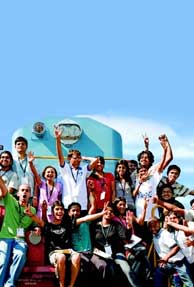
Around 15,000 people registered, of whom 450 were selected on the basis of a questionnaire. There were 35 foreign nationals from countries as diverse as Israel, Britain, South Africa and Argentina. "We include foreigners as they give an outsider's perspective to things," Dixit said.
But as theatre director Lewis Hallam famously put it, 'a journey is not undertaken without money', the yatra cost 34,000 per person. And for those who couldn't afford it, it was just 4,000 as the sponsors took care of the rest.
At a stopover for the yatris in Delhi, there was electrifying energy in the packed Kamani auditorium. The hall resonated with words like "amazing", "awe-inspiring", "incredible", "challenging" as participants sat down to review the journey.
"When you put 450 smart, bright people in a crazy train, amazing things happen. You have real high-level conversations about philosophy, education, history and everything," said Shay Eyal, owner of a start-up firm in Israel, shouting to make himself heard in the noise.
Then there was Abdul Kaleem from Uttar Pradesh's Deoria who participated as he wanted "to work for a sustainable model of education" in his district.
The participants got to witness the development taking place in the far corners of the country through innovative development initiatives, and interacted with those at the forefront of change.
The gender ratio inside the train was 60 males to 40 females.
According to Quinton Fivelman, currently working in Britain, "the train is like a pressure cooker with many cultures coming together. When you live in a small place, there's certain intimacy you develop."
"Some people from south India hadn't even got their winter clothes because they had never been to cooler climates, so there was a lot of sharing," Fivelman told IANS.
The participants met Infosys' N.R. Narayan Murthy; S. Aravind, who founded one of the most productive eye care facilities in Madurai; R. Elango, credited with transforming Kuthambakkam Village in Chennai, among other role models.
But how much of this initiative leads to tangible results? "Around 120 of our ex-participants have become entrepreneurs," said Dixit.
Britain's Richard Russell had been working in an Odisha NGO for a year. Ask him about his train experience and he takes a moment's pause to put his thoughts in order.
"I've been able to learn about enterprise models and ways of approaching development problems. We went to a village transformed by solar power, another one redeveloped by social enterprise," Russell told IANS.
40-120. We want to convert these job seekers into job creators," Dixit said.
An Indian Railways train was booked for the Dec 24-Jan 8 journey with specially equipped bathrooms and private caterers.
Around 15,000 people registered, of whom 450 were selected on the basis of a questionnaire. There were 35 foreign nationals from countries as diverse as Israel, Britain, South Africa and Argentina. "We include foreigners as they give an outsider's perspective to things," Dixit said.
But as theatre director Lewis Hallam famously put it, 'a journey is not undertaken without money', the yatra cost 34,000 per person. And for those who couldn't afford it, it was just 4,000 as the sponsors took care of the rest.
At a stopover for the yatris in Delhi, there was electrifying energy in the packed Kamani auditorium. The hall resonated with words like "amazing", "awe-inspiring", "incredible", "challenging" as participants sat down to review the journey.
"When you put 450 smart, bright people in a crazy train, amazing things happen. You have real high-level conversations about philosophy, education, history and everything," said Shay Eyal, owner of a start-up firm in Israel, shouting to make himself heard in the noise.
Then there was Abdul Kaleem from Uttar Pradesh's Deoria who participated as he wanted "to work for a sustainable model of education" in his district.
The participants got to witness the development taking place in the far corners of the country through innovative development initiatives, and interacted with those at the forefront of change.
The gender ratio inside the train was 60 males to 40 females.
According to Quinton Fivelman, currently working in Britain, "the train is like a pressure cooker with many cultures coming together. When you live in a small place, there's certain intimacy you develop."
"Some people from south India hadn't even got their winter clothes because they had never been to cooler climates, so there was a lot of sharing," Fivelman told IANS.
The participants met Infosys' N.R. Narayan Murthy; S. Aravind, who founded one of the most productive eye care facilities in Madurai; R. Elango, credited with transforming Kuthambakkam Village in Chennai, among other role models.
But how much of this initiative leads to tangible results? "Around 120 of our ex-participants have become entrepreneurs," said Dixit.
Britain's Richard Russell had been working in an Odisha NGO for a year. Ask him about his train experience and he takes a moment's pause to put his thoughts in order.
"I've been able to learn about enterprise models and ways of approaching development problems. We went to a village transformed by solar power, another one redeveloped by social enterprise," Russell told IANS.
Source: IANS