
0
SiliconIndia

Advertise

with us

  • Home
  • Viewpoint
  • News
  • Conferences
  • Magazine
  • Subscribe
  • About Us

THANK YOU FOR SUBSCRIBING


Obtaining Value from Data as an Asset

Amit Shivpuja, Director of Data Governance and Strategy - Merchandising at Walmart

Tweet

Amit Shivpuja, Director of Data Governance and Strategy - Merchandising at Walmart

We are in a Data world where we constantly hear “Data is the new Oil”, “I want to be a Data Scientist or work in Artificial Intelligence”, What data is XYZ company collecting? And/ or what are they doing with it? In effect data has a value and as it continues to grow exponentially - 463 ZB of data will be created every day by 2025. (Raconteur, 2020). Data plays an important role in our digital lives.
This brings up the question - Are we as organizations treating data as the asset it is to obtain value? While the topic of data valuation is significant and an exciting topic by itself, I would like to share my perspectives of what it takes for any organization to get value from data. These perspectives are applicable irrespective of industry, revenues, number of employees etc. i.e., I have used and continue to use them across my diverse global experience.

Let’s start by focusing on what makes Data valuable. To me it is the ability to generate “insights” by analyzing, manipulating, processing or wrangling data. So, what is an “insight”? An insight to me is when a data informed step leads to two results – it generates more data and enables an action. The action here could be anything from an email to a campaign, to not launching an initiative… These insights are what contribute to the value of data. So, in a way, the value of data is in the eye of the beholder.

So, what are the ingredients needed to set up the ecosystem that allows data to enable insights. In my view the best metaphor is a sandwich:


The slices of domain/ industry and security & compliance bring together an organization’s data, technologies, algorithms, and people through strategic governance and processes to create the ecosystem that generates insights. Take the current hot topic of Generative Artificial Intelligence (Gen AI) E.g., ChatGPT. To succeed qualified and authorized people with an understanding of the domain/ industry must securely use accessible governed data, to tune Gen AI algorithms, generating relevant patterns leading to decisions and insights. This will take a few iterations before identification of the best insight, i.e., a longer term or strategic approach is needed.

Sadly, data has until recently been a second thought in organizations. Meaning that it was a side-effect to an organization’s operations, products developed or even processes/ strategies. There was not much thought given to what the long-term implications/ impact of data. However, now organizations are beginning to realize that we cannot just blindly “grab” as much data or keep building data siloes. It is expensive and mismanagement of the data exposes an organization to unnecessary risks – privacy concerns, loss of competitive advantage, etc. So how does one build a stable data organization?

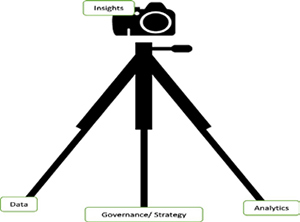
From what I have seen successful and mature data organizations are structured like tripods.

They have focuses on Data, Analytics and Governance/ Strategy. The Data pillar ensures that relevant quality data is available to the relevant folks in a robust, repeatable, and easy to access/ use format or location. The Analytics focus uses the data to identify patterns and enable insights. Yes, I am including AI, Machine Learning (ML) and Data Science in analytics as to me their goal is the analysis of data using different tools/ skills.

From what I have seen successful and mature data organizations are structured like tripods

Lastly, the Governance/ Strategy focus keeps the long term and effectiveness goal in mind to ensure that (in a repeatable fashion) the attention and efforts of data happen with the right tools, with the optimum processes and with a longer-term goal in mind. So, if you are investing in data, AI, analytics, spare some time to strategically invest in governance through stewardship at a minimum. Also, since people are key, and I mean not only the people in the three focus areas above but also consumers, enablers and producers do NOT forget to strategically invest in their continued data literacy. Data value generation takes a village.

The last thing I would like to stress is the importance of security and compliance. While data protection can feel dry like many legal topics, it is non-negotiable. Why would an organization want to invest time and effort trying to squeeze value out of data while there are leaks? As part of data literacy do not stop educating every employee about privacy, company policies, regulations, regional or global compliance. This ensures that every person from those who just “touch” data to those who are neck deep in it are all responsibly involved and enabling value generation.

In conclusion, whether you are a startup, a midsize company or a fortune 100 enterprise, you want value from data; you should significantly invest in not just tools, algorithms, and people but also a strategic perspective and governance. So as an organizational DATA leader I highly recommend building teams that have expertise in the tripod. Additionally, please invest in data governance and data strategy leaders to start or continue down the recommended path (using the “sandwich” and “tripod”) to effectively generate value from data through insights.

Weekly Brief

loading
ON THE DECK
Previous Next

I agree We use cookies on this website to enhance your user experience. By clicking any link on this page you are giving your consent for us to set cookies. More info

© 2025 siliconindia.com All rights reserved.