
 Processing .....please wait..
  The article has been forwarded....
Reassessing India's Role as a U.S.-Backed Net Security Provider in the Indo-Pacific
By siliconindia
|
Thursday, 07 August 2025, 01:19 IST


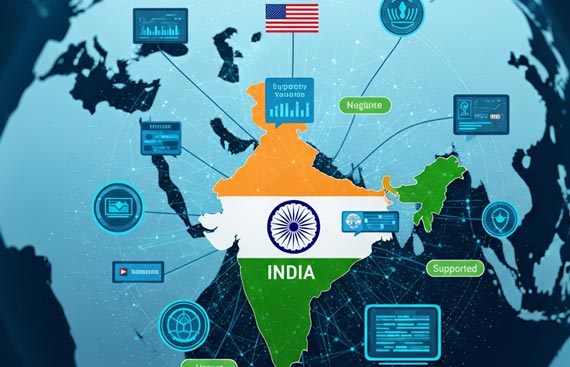
Fremont, CA: As the US consolidates its position as the world’s leading superpower, it has adopted a two-pronged strategy: reinforcing traditional alliances and forging new strategic partnerships. Among the most significant of these is its evolving relationship with India. Through consistent bipartisan support across Democratic and Republican administrations, Washington has deepened ties with New Delhi across political, defense, economic, and diplomatic spheres. The partnership is not new but has steadily matured over the years, culminating in a breakthrough in July 2005 when both nations signed landmark agreements on defense and high-end technology cooperation. These agreements symbolized Washington’s recognition of India as a pivotal strategic actor in South Asia and the broader Indo-Pacific.
The U.S.-India Strategic Partnership
Several drivers underpin the U.S. embrace of India. Chief among them is India’s democratic credentials, its expanding economic and military clout, and its geostrategic location along vital maritime trade routes in the Indian Ocean. Perhaps most crucially, both nations share a mutual concern over China’s rising assertiveness. This shared strategic anxiety has led the U.S. to promote India as a “net security provider” in the Indian Ocean Region (IOR) and beyond—a concept formally articulated by the U.S. Secretary of Defense in 2009. In this envisioned role, India would build regional capacity, engage in military diplomacy, provide defense exports, and undertake military interventions in times of crisis. However, translating this vision into reality reveals a series of constraints on India’s side.
Constraints on India's Strategic Autonomy
India’s continued insistence on strategic autonomy is also shaped by its ambition to lead the Global South and avoid being drawn into binary power blocs. It is not a formal U.S. treaty ally and resists security obligations that could compromise its independent foreign policy. This stance is further complicated by Washington’s ongoing engagement with Pakistan, which remains a point of contention in New Delhi. A more recent factor casting doubt on India’s reliability as a security provider is the brief but intense conflict with Pakistan from May 7 to 10, 2025. The episode exposed operational shortcomings in India’s military readiness, despite significant U.S. investment in defense modernization and intelligence cooperation.
These constraints collectively suggest that U.S. expectations for India to function as a reliable net security provider are both overly optimistic and misaligned with India’s current capabilities and strategic posture. India appears more inclined to use the China challenge as leverage for geopolitical and technological gains, rather than commit to direct security responsibilities in the Indo-Pacific. While its strategic importance to the United States remains undisputed, Washington must adopt a more measured and realistic approach, recognizing that India’s ambitions, internal limitations, and regional priorities limit its capacity to serve as a consistent security guarantor. India may continue to deepen its engagement with the West, but it is unlikely to abandon its commitment to strategic autonomy or assume roles that entail formal military obligations.