
 Processing .....please wait..
  The article has been forwarded....
Innovations in Analog Memory and Architecture
By siliconindia
|
Friday, 25 April 2025, 21:54 IST


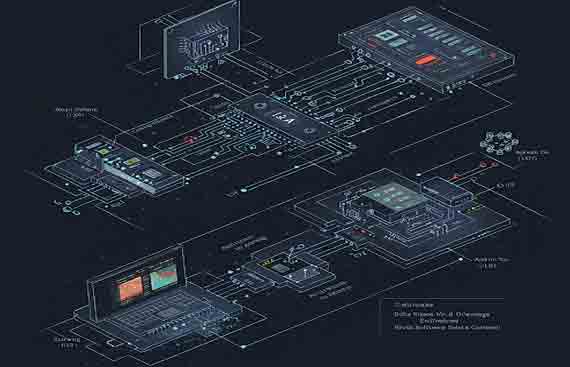
Artificial Intelligence (AI) is undergoing a significant transformation, driven by advancements in algorithms and a critical evolution in the underlying hardware and software infrastructure. As AI models—intense neural networks—continue to expand in scale and complexity, the energy consumption and computational demands imposed by conventional digital hardware architectures have emerged as substantial challenges. These limitations have catalyzed renewed interest and innovation in Analog AI. This paradigm leverages the intrinsic properties of analog circuits and emerging memory technologies to execute computations, particularly AI inference, with potentially orders-of-magnitude improvements in energy efficiency and speed.
Foundations of Analog AI
At its core, Analog AI represents a departure from the traditional von Neumann architecture, which separates processing and memory units—an arrangement that results in considerable energy loss and latency due to constant data shuttling, often called the “memory bottleneck.” Analog AI embraces Compute-in-Memory (CIM)—also known as Processing-in-Memory (PIM)—to address this inefficiency. In CIM architectures, core operations of AI, particularly matrix-vector multiplication (MVM), are executed directly within memory arrays.
These memory elements, frequently based on advanced non-volatile memory (NVM) technologies, are engineered to serve dual purposes: storing synaptic weights and modulating electrical signals to represent neural activations. Fundamental physical laws such as Ohm’s Law and Kirchhoff’s Law are harnessed to perform multiply-accumulate operations in the analog domain—within the memory itself—thereby enabling highly parallelized, low-power computation and significantly reducing data movement.
Neuromorphic Computing: Brain-Inspired Efficiency
Complementing CIM, Neuromorphic Computing represents another significant trajectory within the Analog AI landscape. Drawing direct inspiration from the brain’s structure and function, neuromorphic systems replicate the behavior of neurons and synapses using analog or mixed-signal circuits. These architectures often employ Spiking Neural Networks (SNNs), which transmit information via discrete temporal events, or "spikes," emulating biological neural behavior. This event-driven model ensures that computation occurs only when required, offering substantial energy savings, especially in applications involving sparse data or real-time sensory input.
In practice, fully analog systems remain uncommon. The prevailing trend is toward hybrid architectures that strategically integrate analog and digital components. Dense analog compute cores perform energy-efficient MVM operations, while digital elements manage precision-critical tasks such as control flow, data routing, activation functions, and external communication. Advanced interconnect strategies—often involving 3D integration—enable seamless interaction between analog and digital domains, facilitating high-performance data exchange and minimizing internal bandwidth bottlenecks.
Enabling Technologies and the Software Imperative in Analog AI Hardware
The advancement of analog AI hardware is deeply rooted in innovations in materials science and device physics, particularly in the development of memory technologies that store synaptic weights and perform computations. Various non-volatile memory (NVM) technologies have been instrumental in this evolution. Phase-Change Memory (PCM) leverages materials that switch between amorphous and crystalline states to achieve multiple resistance levels per cell, enabling analog weight storage. Resistive RAM (RRAM), or memristors, operates via voltage-induced resistance changes in dielectric materials, offering high-density and low-power performance. Magnetoresistive RAM (MRAM) utilizes magnetic tunnel junctions, valued for their high endurance and speed. Ferroelectric FETs (FeFETs) integrate ferroelectric materials within transistor gates to facilitate non-volatile threshold voltage modulation. Additionally, capacitor-based analog memory uses charge stored on capacitors, typically within CMOS processes, to perform functions such as accumulation through charge sharing.
Beyond memory components, the efficiency and precision of Analog-to-Digital Converters (ADCs) and Digital-to-Analog Converters (DACs) are critical to the performance of hybrid analog systems. These converters serve as vital interfaces between analog compute cores and digital peripherals. ADC/DAC design innovations, tailored explicitly to AI workloads, emphasize reduced precision requirements, increased speed, and lower power consumption. Techniques such as time-based conversion directly integrated within compute cores are gaining traction. A key enabler for scalable and cost-effective deployment is the compatibility of these analog components with standard CMOS fabrication processes, allowing for seamless integration alongside digital logic.
Realizing the full potential of analog AI hardware also requires a robust and specialized software ecosystem. As AI models are typically developed using high-level digital frameworks like TensorFlow or PyTorch, translating these models to analog hardware entails several essential processes. Model mapping and compilation software tools convert trained neural networks into formats suitable for analog hardware, including quantization, network partitioning, and device-specific optimization.
Hardware-aware training techniques are employed to address the inherent variability and imperfections of analog devices. During the training phase, these methods simulate analog characteristics, such as noise, limited precision, and non-linearity, enabling models to develop robustness and accuracy for real-world deployment on analog chips. Research is also advancing in situ and on-chip learning techniques to enhance adaptability.
Furthermore, accurate simulation and emulation environments are indispensable. These tools model analog hardware behavior at device and circuit levels, allowing developers to verify performance, identify issues, and assess design trade-offs before hardware fabrication. A comprehensive runtime environment is also necessary to manage task execution, data transfers between digital and analog domains, and the configuration of analog arrays. APIs abstract the underlying hardware complexities, enabling seamless interaction with higher-level software applications. Emerging integrated toolchains now provide end-to-end workflows—from model ingestion and optimization to deployment and performance evaluation—facilitating the broader adoption and commercialization of analog AI platforms.
Analog AI represents a rapidly evolving frontier in computational technology. Spurred by the increasing demands of modern AI and the scaling limitations of conventional digital systems, this domain leverages the fundamental efficiencies of analog computation, novel materials, and biologically inspired architectures. The convergence of hardware innovation in compute-in-memory and neuromorphic design and advancements in supporting software toolchains is driving a new generation of ultra-efficient AI processors.
Though challenges remain, progress is substantial and accelerating. Analog AI promises to enable complex AI capabilities in energy-constrained environments and reshape the energy profile of AI computing across the edge-to-cloud continuum. Its multidisciplinary foundation—encompassing physics, materials science, circuit design, computer architecture, and software engineering—highlights the field’s transformative potential in redefining how AI is implemented and scaled.