2025 HR Milestones That Redefined Talent Management in India
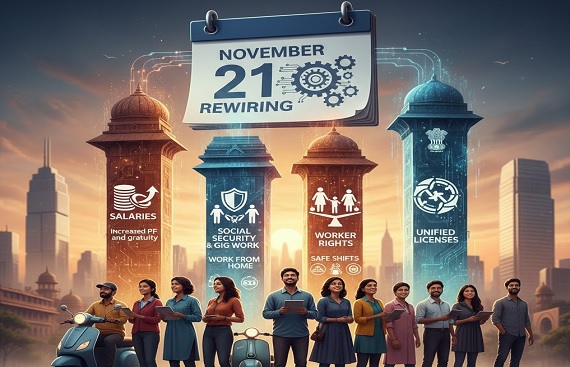
- Labour Codes 2025 reset salaries, social security, and gig work
- Basic pay set at 50 percent of CTC boosting PF and gratuity
- Workforce rights strengthened with floor wage, gender parity, WFH, safe shifts, and unified licenses
As the year close ends, India's HR landscape looks transformed, with one event eclipsing all others: the long-awaited rollout of the four new Labour Codes on November 21. What started as cautious optimism in January with companies fine-tuning hybrid policies, upskilling programs, and DEI initiatives amid a 23percent hiring surge exploded into urgent action mid-November.
Suddenly, payrolls needed rewiring, contracts rewriting, and entire workforces reassessing their financial futures. These codes didn't just update rules, they rewrote the social contract between employers and employees, forcing a shift from maximising today's take-home to securing tomorrow's dignity.
In a nation where millions hustle in gig jobs or informal setups, this wasn't mere compliance it was a quiet revolution, blending short-term adjustments with profound long-term gains.
In the recent IAMPhenom India 2025 event on 18 December, the role of AI in talent management took center stage, with Hari Bayireddi, President, COO & Co-Founder of Phenom, highlights, “India’s talent landscape is evolving rapidly, and HR teams need applied AI that not only improves efficiency but also closes the persistent gaps between workforce data, strategy, and execution. With these innovations, we are enabling organisations in India to connect strategy, skills, and execution whether it’s accelerating hiring, redesigning work, or ensuring the integrity of every hire”.
The Salary Rewrite
Imagine opening your payslip and seeing the numbers rearranged overnight. That's the reality post-November 21 under the Code on Wages.
The standout rule, basic salary (plus dearness and retaining allowances) must now form at least 50 percent of total CTC. For years, savvy structures kept basic low often 25-35 percent parking the rest in allowances to inflate take-home while minimising PF and gratuity outflows.
Take an Rs 15 lakh CTC example.
Old setup: Rs 4 lakh basic meant modest PF (around Rs 48,000 yearly).
New reality: Rs 7.5 lakh basic spikes PF to Rs 90,000, potentially shaving Rs 3,000-4,500 monthly from your pocket unless CTC rises.
Gratuity soars too now based on higher basic, boosting payouts 50-80 percent.
Fixed-term workers?
They qualify after one year, not five.
HR teams spent December scrambling, auditing structures, modelling tax shifts (higher basic could nudge brackets), and counselling on voluntary NPS top-ups.
Yet, this pain funds a greater good swelling EPFO's Rs 23 lakh crore corpus by billions annually, creating domestic savings to fuel infrastructure without volatile foreign inflows.
As Ashok Chandak, President, IESA and SEMI India, says, “Mandatory appointment letters, universal minimum wages, and pan-India social security coverage (including ESIC expansion) ensure greater formalisation. This strengthens worker confidence -critical for skill-intensive manufacturing such as fabs, ATMP, component manufacturing and design centres”.
Also Read: RBI's Groundbreaking Regulatory Moves of 2025
2025 Workforce Reset

If salary tweaks hit white-collar India hardest, the Social Security Code delivered magic for the invisible millions. For the first time, gig and platform workers Swiggy riders, Uber drivers, Urban Company pros are legally recognised. Aggregators must contribute 1-2 percent of turnover (capped at 5 percent of worker payouts) to funds covering health, maternity, disability, and pensions.
12 Game-Changing Rules in 2025
- National Floor Wage: No state can fix minimum wages below the Centre’s floor level. Universal minimum wage for the first time.
- No Gender Discrimination: Same work, same wage legally enforceable.
- Free Annual Health Check-up: Mandatory for every employee above 45 (some drafts say 40).
- Work-From-Home Formalised: Allowed in service sectors by mutual agreement.
- Women Night Shifts Legalised: With consent and strict safety protocols (transport, CCTV, etc.).
- Overtime Pay Doubled: Minimum 2× normal rate, no more compensatory off loopholes.
- Annual Leave After 180 Days: Earlier it was 240 days.
- Appointment Letter Mandatory: Even for unorganised-sector workers.
- Commuting Accidents Covered: Accident while travelling to/from work now counts as employment injury.
- Layoff Threshold Raised: Factories with up to 300 workers can lay off without government permission (earlier 100).
- One Nation, One License: Contract labour licence valid across India for five years.
- Strike Notice Mandatory: 14 days’ notice even for mass casual leave.
Winding It Up!
2025 began with incremental HR wins hybrid refinements, talent wars in Tier-2 cities. It ends with a foundational reset.
November 21 wasn't just a date, it was India's declaration that work deserves security, not precarity. Thinner wallets today fund richer retirements, gig hustles gain dignity.
Critics note transition pains, compliance hurdles, potential dips, but the trajectory is clear: a resilient workforce powering Viksit Bharat.
HR leaders aren't just adapting, they're architecting inclusive, future-proof cultures. As payslips evolve, one certainty emerges, talent management in India has matured, prioritising people over paperwork for generations ahead.