Ratan Tata's Legacy of Leadership, Integrity and Philanthropy
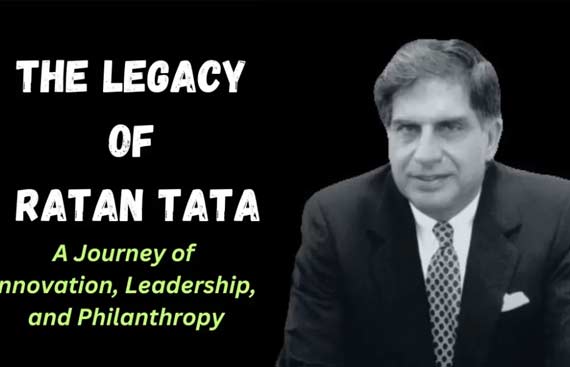
Ratan Tata elevated the Tata Group globally while contributing to society through philanthropy, education and healthcare, leaving a lasting legacy of ethical leadership.
Revered industrialist Ratan Tata is remembered for elevating the Tata Group to new heights while contributing significantly to various societal causes. Known for his humility, compassion and integrity, Tata had a visionary leadership and ethical approach to business. He was awarded the Padma Vibhushan, India’s second-highest civilian honor, in 2008. Tata assumed leadership roles as Chairman of Tata Sons and the Tata Trusts in 1991, a pivotal year when India underwent major economic reforms. He navigated these reforms and managed challenges that came his way, continuing his leadership for over two decades before retiring in 2012.
Early Life and Education
Born on December 28, 1937, to Naval and Soonoo Tata, Ratan Tata and his younger brother Jimmy were raised by their grandmother, Navajbai R Tata, in a grand residence called Tata Palace in Mumbai. Tata's journey to education took him to the United States at the age of 17, where he pursued studies in architecture and engineering at Cornell University. After seven years, he earned his bachelor’s degree in architecture in 1962. His time in America, particularly in California, left a lasting impact on him, and he even considered settling in Los Angeles before being called back to India due to his grandmother’s health issues.
Early Career at Tata Group
Upon returning to India, Tata initially had a job offer from IBM, but Jehangir Ratanji Dadabhoy (JRD) Tata, not pleased with his decision, offered him a position with Tata Industries. Tata joined the group in 1962, working first at Telco, now Tata Motors and then at Tata Steel (formerly Tisco) in 1963. His career in the group grew as he was appointed technical officer at Tata Steel in 1965. He also worked as Tata’s resident representative in Australia in 1969 and returned to India in 1970 to work for Tata Consultancy Services, an emerging software business.
Progression through Tata Group Leadership
In 1971, Tata became director of National Radio and Electronics (NELCO). He joined the board of Tata Sons in 1974 and completed the Advanced Management Program at Harvard Business School the following year. Tata’s leadership journey continued when he was appointed chairman of Tata Industries in 1981. Under his leadership, Tata Industries transformed into a promoter of high-technology businesses. He was also instrumental in drafting the Tata strategic plan in 1983 and served as Chairman of Air India from 1986 to 1989.
Restructuring and Global Expansion
Tata began restructuring the Tata Group in 1991. From the turn of the millennium, under his leadership, the group embarked on a significant global expansion, making high-profile acquisitions, including Tetley, Corus, Jaguar Land Rover, Brunner Mond, General Chemical Industrial Products and Daewoo. One of Tata’s notable achievements was the launch of the Tata Nano in 2008, the world’s most affordable car, which gained international attention. Tata famously kept his promise, ensuring the Nano’s base variant was priced at Rs 1 lakh (ex-factory).
Retirement and Legacy
After over 50 years with Tata Group, Ratan Tata retired as Chairman of Tata Sons but continued to serve as Chairman Emeritus. Tata’s leadership was marked by a dedication to innovation, excellence and ethical business practices. His contributions to society, primarily through philanthropy, have left an indelible mark on various fields, including education and healthcare. Under his stewardship, the Tata Group expanded its global footprint while staying true to its moral compass.
Tributes and Reflections
Following Tata’s passing on Wednesday evening, tributes poured in from across political spectrums and industries in India and abroad. N Chandrasekaran, the current Chairman of Tata Sons, praised Tata’s dedication to business and philanthropy, stating that his initiatives had touched millions of lives and would continue to benefit future generations. Tata's unwavering commitment to societal development extended beyond corporate success to improving education and healthcare. Tata’s humility in every interaction was also deeply admired by those who worked with and knew him.
As tributes continue to flow in, it is clear that Tata's impact on India and the world will be felt for many years to come. This solidifies his place as a titan of industry whose contributions transcended mere commerce, ultimately enriching the fabric of society itself.