NITI Aayog Unveils $25 Billion Export Vision for India's Hand & Power Tools Sector
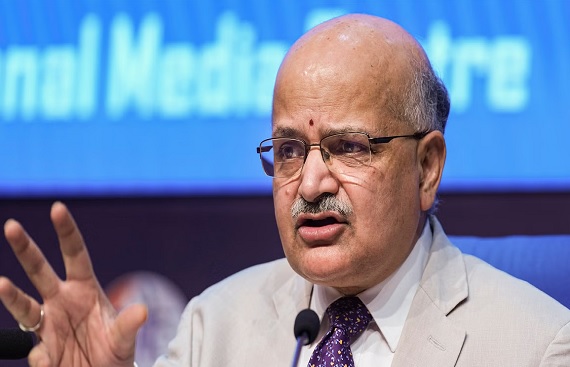
NITI Aayog has launched a wide-ranging roadmap for bringing India's hand and power tools industry's over $25 billion export potential by 2035, underlining its huge potential in becoming a force to strengthen India's manufacturing ecosystem, generate employment, and make India a world manufacturing hub. The strategic report 'Unlocking $25+ Billion Export Potential - India's Hand & Power Tools Sector' was formally released by Shri Suman Bery, Vice Chairman, NITI Aayog, in the presence of Dr. V.K. Saraswat and Dr. Arvind Virmani, Members of NITI Aayog, and Shri BVR Subrahmanyam, CEO of NITI Aayog.
The report highlights the transformational capabilities of India's power and hand tools industry and how it can propel the country's economic goals towards the Viksit Bharat @2047 vision. It delves into the prevailing international market scenario, national challenges, and the strategic interventions necessary to raise India's global level in this critical sector.
Today, the international trade in hand and power tools is worth approximately $100 billion and is estimated to reach $190 billion by 2035. Of this, the hand tools market is anticipated to grow from $34 billion to $60 billion, and the power tools market, including tool accessories, will increase from $63 billion to a staggering $134 billion. Electrical tools are likely to lead this market.
Despite the expanded global market, India's market share is not very high. India currently maintains only 1.8% of the market share of hand tools with exports of $600 million and 0.7% of power tools with exports of $470 million. The opposite is seen in China as it maintains 50% in hand tools and 40% in power tools, exporting worth $13 billion and $22 billion respectively.
But the report does see a huge opportunity for India to significantly raise its exports to $25 billion in the next 10 years, if the right policy interventions are made. Meeting this target could create approximately 35 lakh jobs, with a projected 25% world market share in hand tools and 10% in power tools.
To realize this ambitious target, the report suggests a three-pronged approach:
1. Creation of World-Class Industrial Clusters:
The report suggests the development of 3-4 integrated clusters of hand and power tools spread over around 4,000 acres. The clusters would be developed through a public-private partnership (PPP) model with plug-and-play infrastructure, worker accommodation, convention centers, and good connectivity to ease manufacturing and export operations.
2. Structural Cost Reforms:
India currently suffers from a 14-17% cost disadvantage vis-a-vis China owing to very high raw material prices (steel, plastic, motors), reduced labor productivity, overtime rules, and higher logistics and funding prices. The report suggests various reforms like rationalising Quality Control Order (QCO) curbs, lowering import duties on critical raw material imports, and streamlining the Export Promotion Capital Goods (EPCG) scheme. It also proposes relaxing Authorized Economic Operator (AEO) standards and making changes to labor and construction legislation to improve competitiveness.
3. Bridge Cost Support:
Although the report reiterates that there is no requirement for new subsidies if market reforms are effectively implemented, it does point to the need for interim support to overcome cost disadvantages. In the absence of structural reforms, a further  8,000 crore might be required in bridge cost support. This investment, according to the report, should be viewed as catalytic and not as a subsidy and has the potential to return 2-3 times its value in tax revenues in five years.
8,000 crore might be required in bridge cost support. This investment, according to the report, should be viewed as catalytic and not as a subsidy and has the potential to return 2-3 times its value in tax revenues in five years.
The report positions the hand and power tools sector as a key driver of India's manufacturing expansion, powering industries like construction, automobile, home improvement, and infrastructure. It also highlights that the sector is key to India's Make in India policy, which aims to stimulate domestic manufacture and lower import dependence.
"This is not about tools, but about creating the tools of development," Shri Suman Bery stated at the launch, highlighting the sector's contribution to employment generation, industrial empowerment, and competitiveness in global trade".
As India looks to become a developed country by 2047, the hand and power tools sector can be at the forefront in making this happen. With the concerted efforts of government agencies, industry players, and MSMEs, India can substantially increase its global presence and establish itself as a trustworthy and quality-oriented manufacturing hub.
With the appropriate combination of infrastructure, policy changes, and focused support, the coming decade can be a historic turning point for India's manufacturing sector translating tools into triumphs on the world stage.