

ISRO Commences Assembly of HLVM3 for Gaganyaan Launch in 2025
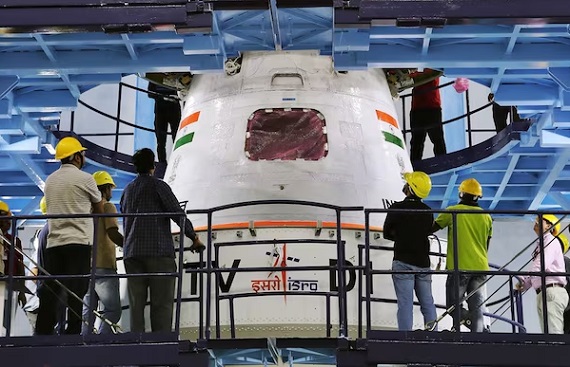
India's space exploration efforts have achieved a significant milestone with ISRO beginning the assembly of the Human-Rated Launch Vehicle Mark-3 (HLVM3) at the Satish Dhawan Space Centre (SDSC). This marks the official start of the Gaganyaan-G1 mission campaign, which is scheduled for 2025. This mission will be India's first uncrewed flight as part of the Gaganyaan human spaceflight program.
The timing of this development coincides with the 10th anniversary of the LVM3-X/CARE mission, which took place on December 18, 2014. This earlier mission demonstrated key technologies for human spaceflight, providing valuable data that laid the foundation for the Gaganyaan program.
The 2014 mission demonstrated critical technologies for human spaceflight, including the successful launch and recovery of a Crew Module. During that mission, the LVM3-X lifted a 3,775 kg Crew Module to a suborbital altitude of 126 km, followed by a controlled re-entry and splashdown in the Bay of Bengal.
These achievements laid the groundwork for the Gaganyaan program, officially approved in 2019.
The HLVM3, an evolution of the LVM3, has been specifically designed for human spaceflight with enhanced reliability and safety systems. It is a three-stage vehicle standing 53 meters tall, weighing 640 tonnes, and capable of carrying 10 tonnes to low Earth orbit (LEO).
Key upgrades include a human-rated design and the integration of a Crew Escape System (CES), which can safely eject the Crew Module in the event of an anomaly during ascent.
Isro began stacking the nozzle-end segment of the S200 solid rocket motor on Wednesday, officially launching the HLVM3-G1 campaign.
The S200 motors are undergoing assembly, while the L110 liquid stage and C32 cryogenic stage are ready for integration at the launch complex. Meanwhile, the Crew Module is being integrated at the Vikram Sarabhai Space Centre (VSSC), and the Service Module at the U.R. Rao Satellite Centre (URSC).
The Orbital Module’s final integration and testing will follow at URSC, Bengaluru.
The HLVM3-G1 mission is critical for testing the human-rated systems in an uncrewed environment.
The Crew Module features advanced safety margins, multiple redundancies, and re-entry technologies validated through the LVM3-X/CARE mission. This data will be instrumental in ensuring the success of future manned missions.
Isro’s legacy in developing heavy-lift launch vehicles has been pivotal for India’s space ambitions. The insights from earlier missions have guided the design of the Gaganyaan spacecraft, with lessons from pad abort tests, air-drop experiments, and system evaluations ensuring readiness for human spaceflight.
The maiden Gaganyaan flight will also contribute to India’s long-term vision of building the Bharatiya Antariksh Station (BAS).


