India-U.S. Defense Partnership in the Indo-Pacific Era
India and the U.S. are on the verge of signing a landmark 10-year defense partnership framework that is expected to solidify and expand bilateral cooperation in areas such as joint military exercises, defense technology development, and arms procurement.
Strengthening Bilateral Defense Ties
Following a call in July 2025 with U.S. Secretary of Defense Pete Hegseth, Indian Defence Minister Rajnath Singh characterized the discussion as productive and forward-looking. He noted the review of ongoing efforts and the identification of new initiatives aimed at deepening the defense partnership and enhancing capacity-building cooperation. Singh also conveyed appreciation for the U.S.’s continued support of India’s counterterrorism initiatives.
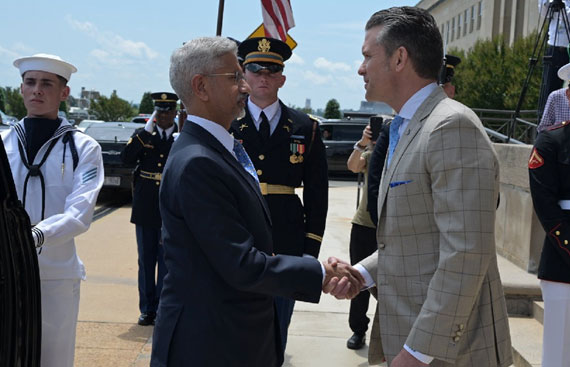
Secretary Hegseth met with Indian External Affairs Minister Subrahmanyam Jaishankar at the Pentagon in Washington, D.C. Hegseth emphasized the strength of the bilateral relationship, highlighting a “rich and expanding history of cooperation” rooted in a shared commitment to a Free and Open Indo-Pacific. He affirmed the U.S.’s readiness to work closely with India to advance mutual strategic objectives through sustained collaboration.
Advancing Strategic Collaboration in the Indo-Pacific
As members of the Quadrilateral Security Dialogue (Quad) alongside Australia and Japan, India and the U.S. collaborate on a broad spectrum of strategic areas, including maritime domain awareness, supply chain resilience, critical mineral development, emerging technologies, and humanitarian assistance and disaster response. The Quad also conducts joint military activities, notably the Malabar naval exercise, which was hosted by India in the Bay of Bengal in 2024. In addition to multilateral cooperation, India and the U.S. engage in bilateral defense initiatives such as the annual Tiger Triumph exercise. The 2025 iteration, held in India in April, involved approximately 3,000 personnel, four naval vessels, and seven aircraft, significantly enhancing operational readiness and interoperability between the two forces.
New Delhi has increasingly sought defense procurement and co-production partnerships with countries such as the United States, aiming to enhance its military capabilities through strategic collaboration. The Indian Armed Forces have incorporated a range of U.S.-manufactured defense assets, including transport and maritime surveillance aircraft, attack helicopters, uncrewed aerial vehicles, armored vehicles, and advanced munitions such as howitzers and anti-ship missiles, as noted by the U.S. Department of Defense.
Building on this momentum, U.S. officials have expressed optimism about finalizing several significant pending defense sales to India. They also emphasized the importance of expanding joint industrial cooperation and co-production initiatives, as well as deepening operational interoperability between the two nations' armed forces.
Indian External Affairs Minister S. Jaishankar underscored the strategic significance of the defense partnership, describing it as “one of the most consequential pillars” of the bilateral relationship. He highlighted that the collaboration is founded not only on shared interests but also on a deepening alignment of capabilities and responsibilities. Jaishankar further emphasized that the joint efforts of the two countries in the Indo-Pacific are vital to maintaining strategic stability in the region.