

India's Influence Cannot Be Ignored: Nirmala Sitharaman
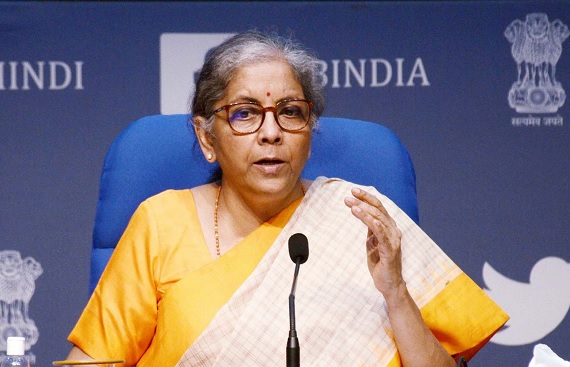
Union Finance Minister of India, Nirmala Sitharaman said that no one can ignore growing influence of India across the globe when she made her presentation at a high-level panel meeting on the sidelines of the Annual Meetings 2024 of World Bank and International Monetary Fund (IMF) in Washington, D.C. The event was organized by Center for Global Development on "Bretton Woods Institutions at 80: Priorities for the Next Decade".
Stressing India's importance to world's leading economic global leaders present on the panel- which included Lawrence H. Summers, from Harvard University; Spain's Economy Minister Carlos Cuerpo; and Egypt's Planning Minister, Rania A. Al Mashat- Sitharaman said both distant global power the United States and a close neighbor China, cannot ignore India. She pointed out that India is the largest democracy in the world, with an ever-growing population, and one in every six individuals across the world is an Indian today.
No country, whether it is the US that is far away or China, very close to India, can ignore India, Sitharaman declared. She also went on to underline that India is not seeking power but striving to maximize its influence because of its sheer population size, growing economy, and skilled workforce.
India, Sitharaman said, had always stood by multilateral institutions, such as the IMF and the World Bank, and never tried to rock them. She acknowledged that expectations from these two institutions have gradually eroded because many solutions to global issues are not forthcoming. However, India continues to stand for multilateralism, she said.
While mentioning how the reform efforts within the multilateral framework can be taken forward by countries like India and other emerging markets, Sitharaman said that one of the growing forces influencing the world is the technological leadership of India. Citing examples, she said Indian professionals - be it in India or out of India - are leading the charge of running complex global corporations and systems, from refining oil to multilateral banking.
Indian Finance Minister further highlighted the part India was playing in harnessing technology and its massive growth in digital public infrastructure and the like. She elaborated on how Indian contributions in those niches sit as part of a global picture, especially because the country is constantly sharing its digital progress with the rest of the world, starting from smaller or island economies.
The IMF and the World Bank, in what is known collectively as the Bretton Woods Institutions, were set up in 1944 as part of a sweeping effort to support post-war economic reconstruction and nurture international economic cooperation. Sitharaman raised concerns in this panel discussion over these institutions' efforts to embrace modern global challenges. She stressed that such institutions should not only be established to stay alive but develop their capabilities, and particularly during crises that engage them, not respond to them but proactively build the future by exchanging critical economic information that fosters the growth of strong institutions all over the world.
One should note that Sitharaman referred to the International Solar Alliance, the Biofuel Alliance, and initiatives towards disaster-resilient infrastructure led by India. She highlighted that all these initiatives need a considerable amount of investment, particularly by smaller and island economies. India becomes a model for cooperation in the international environment as well as in digital infrastructure.
Sitharaman also referenced the vision of Prime Minister Narendra Modi for India's place in the world. The economic and human capital growth that India has witnessed, she said, is not for dominance but for constructive influence. Inclusive growth is one of the major priorities set by the Prime Minister, matching India's approach toward multilateralism-in terms of cooperation rather than competition.
She further elaborated on the dynamic changes in the global development pathways. She repeated what Summers earlier pointed out-that, after all, perhaps the old model of development would not work: that is, from wearing apparel and textiles towards iron and steel industries. She argued persuasively that India was perfectly poised to define a new pathway of development, one that was more knowledge-centric, innovation-driven.
She reaffirmed India's commitment toward global institutions and support toward sustainable development. She emphasized that trying to solve the crisis rather than building economic resilience is the role of institutions like the IMF and the World Bank. Such ones, she said have a lot of institutional knowledge and experience that can be very instrumental in building the economies of the world.
The Finance Minister also referred to India's pursuit of sustainable living through LiFE – Lifestyle for Environment, an inspiring initiative towards encouraging lifestyles that are green. She mentioned that India was very much at the center of the global efforts for climate change and that those countries were working actively in solar energy and biofuels to create a greener future, just like India.
These comments from Sitharaman explicitly outline the mounting influence of India on the global platform. Moving at a rapid pace, with a large and capable workforce together with the commitment toward advanced technology, India is well on its way to becoming a strategic leader for the future of world development. With this participation of the Finance Minister into this panel, it is India that now starts taking active roles in multilateralism and finding its own piece of the puzzle in molding a world into an even more inclusive and much more sustainable one.
Sitharaman's visit to Washington, D.C. during the World Bank and IMF meeting is a crucial moment for India to consolidate its international influence. Her speech at the event echos the globe once more and leaves no ground for ignoring India in the global economic and political playgrounds.
Sitharaman visited New York before reaching Washington, D.C. She met various stakeholders in New York. India's Ambassador to the U.S., Vinay Kwatra, welcomed her to Washington. The Ministry of Finance posted this on X, the microblogging site formerly known as Twitter, to celebrate the arrival of the Finance Minister and her continued efforts to further India's global role.


