

Indian Markets React as Trump-Modi Ties Turn Frosty Over Trade Tensions
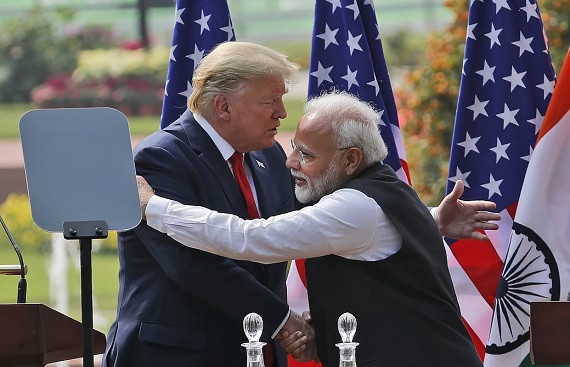
When Narendra Modi dropped in on Donald Trump last week, there was none of the bear-hugging bonhomie that was on display at the White House Rose Garden in 2017. The hand-clasping bromance from the 2019 'Howdy Modi' event in Houston was also missing. The Indian prime minister came bearing trade concessions on Harley-Davidson bikes and Tesla cars, yet the US president met him wielding a fat stick of tariffs.
Trump laid a chill over the highly-awaited meeting by announcing new tariffs, announcing that foreign goods would be taxed at the same rate used to tax American goods by other countries. The action is tougher than his initial campaign threat of a tariff across the board and would have major implications for India. Kotak Mahindra Bank analysts project that nine of India's top ten US exports, such as iron, steel, auto components, pearls, and mineral fuels, would see incremental duties of 6 to 24 percentage points, while the overall tariff hike would be 7 percentage points.
India's loss of competitiveness in its biggest foreign market could add more pressure to the country's currency. Expecting smaller dollar returns, foreign investors could contribute to the almost $11 billion already pulled out of Indian markets this quarter. Higher capital outflows might render it challenging for the Reserve Bank of India to reduce interest rates, despite a slowdown in the economy. Domestic retail investors, who have supported equity prices, could also be prompted to exit, after guidance by a senior local fund manager to sell small-cap stocks altogether.
Tariffs in response will not kick in before Modi reviews trade practices by April 1, buying him time to negotiate a deal. But it will probably call for more concessions, including clearing Elon Musk's Starlink satellite broadband service. The US is also pressuring India to purchase more military equipment, including the F-35 fighter jet. New Delhi has already consented to revise a civil liability law that has held up Westinghouse Electric Co.'s nuclear power projects for more than a decade.
Trump's requirements could go beyond tariffs to encompass subsidy cuts, regulatory reforms, value-added tax adjustments, currency exchange policies, and intellectual property protection. Some of these reforms would improve India's economy by making Indian big companies more competitive. Still, Trump's pressure on India to buy more American oil and gas could put its balance of payments under strain and slow green energy plans. Half of India's liquefied natural gas requirement comes from imports, primarily from the Persian Gulf. Switching to US producers would raise shipping costs and pump up the import bill, making it harder for India to move to solar- and wind-based hydrogen.
At a White House joint press conference, Trump discussed enhancing US-India trade corridors, referring to a corridor linking India with Europe via Italy and Israel. Reviving the India-Middle East-Europe Economic Corridor, which has made little headway since it was announced in 2023, would serve billionaire Gautam Adani, who controls Israel's Haifa port and wants to expand more in Europe. Trump's latest deferment on the Foreign Corrupt Practices Act would also alleviate Adani from legal stress, with Adani Group denying US Department of Justice's bribery complaint filed against the group. Modi labeled the issue a personal concern rather than bilateral negotiations.
The financial markets remain cautious. The stocks of the Adani Group have been weak and have brought the benchmark index lower with subdued corporate earnings. After five years of strong gains, Indian equities are facing valuation concerns. A recently announced $12 billion tax rebate has failed to revive consumer sentiment. Economic concerns are growing, further fueled by the recent deportation of 104 undocumented Indian workers, including some from Modi’s home state of Gujarat, flown back in handcuffs on a US military plane. If Modi extracted any promises of improved treatment for deportees, he did not reveal them. But he did manage to get Trump's pledge to extradite a prime suspect in the 2008 Mumbai terror attacks, a minor diplomatic gain in larger trade tensions.


