India and U.S. Commit to Deeper Defense Collaboration
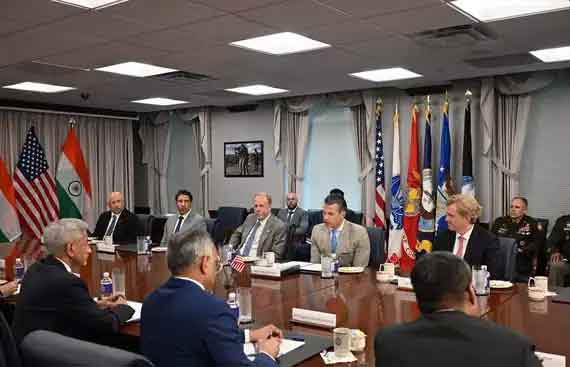
India's External Affairs Minister, S. Jaishankar, and U.S. Secretary of Defense, Pete Hegseth, met bilaterally at the Pentagon, marking a pivotal moment in the developing India-U.S. strategic relationship. The high-level engagement, held on the sidelines of the Quad Foreign Ministers' Meeting (QFMM) in Washington, underscored the growing convergence between the two democracies, particularly in the defense and security domain. Jaishankar highlighted the critical role defense cooperation plays in the broader strategic partnership, referring to it as "one of the most consequential pillars" of the bilateral relationship. His visit to the Pentagon was not merely a courtesy call but a reaffirmation of India's intent to deepen defense collaboration with the United States, aligning with both countries' broader Indo-Pacific strategic frameworks.
Strengthening Interoperability and Strategic Frameworks
The significance of the meeting lies not just in the rhetoric but in the momentum it adds to a partnership already in motion. Over the past decade, India and the U.S. have steadily moved from a buyer-seller defense relationship to one focused on interoperability, technology sharing, and joint development. This shift is driven by shared geopolitical concerns, particularly regarding free and open Indo-Pacific maritime security and the evolving security landscape in Asia. By holding this bilateral meeting at the Pentagon, Jaishankar symbolically and substantively reinforced India's commitment to advancing the defense aspect of its multidimensional ties with the U.S.
Secretary Hegseth echoed this sentiment, expressing strong optimism about the trajectory of the defense relationship. He acknowledged the successful integration of several U.S. defense systems into the Indian armed forces as an outcome of years of procurement deals, defense dialogues, and joint military exercises. The United States now sees an opportunity to build on this progress by finalizing several significant pending defense sales, expanding industrial cooperation, and establishing robust co-production networks. These ambitions aim to transform the defense relationship from transactional to transformational, enabling both countries to co-develop next-generation technologies, share critical supply chains, and bolster regional deterrence.
Industrial Collaboration and Strategic Self-Reliance
A particularly strategic area of focus has been the effort to improve interoperability between the two militaries. It goes beyond just joint exercises and includes sharing logistical support under agreements such as the Logistics Exchange Memorandum of Agreement (LEMOA), intelligence sharing under the Basic Exchange and Cooperation Agreement (BECA), and communications interoperability through the Communications Compatibility and Security Agreement (COMCASA). These foundational agreements form the bedrock of deeper military cooperation, enabling Indian and U.S. forces to operate more seamlessly across platforms and geographies, particularly in maritime and air domains.
In the context of rising regional tensions, particularly in the Indo-Pacific, the India-U.S. defense partnership is becoming increasingly vital. Both nations view each other as key players in ensuring regional stability and counterbalancing assertive behavior from adversarial powers. The Quad grouping, comprising India, the U.S., Australia, and Japan, has emerged as a central platform for aligning strategic interests and enhancing regional security. Jaishankar's remarks at the Pentagon also alluded to this alignment, as he noted the strength of discussions with his Quad counterparts, reinforcing the idea that India's defense ties with the U.S. are not isolated but part of a broader, multilateral security framework.
Similarly, the push for expanding defense industrial cooperation signifies India's broader goal of defense indigenization and technological self-reliance. This is encapsulated in its 'Make in India' initiative, which aims to promote domestic manufacturing, and the 'Atmanirbhar Bharat' initiative, which focuses on self-reliance and reducing dependence on imports. The U.S., in turn, is seeking to diversify its defense manufacturing partnerships and minimize supply chain dependencies on strategic competitors. The convergence of these interests opens the door to joint ventures, technology transfers, and co-development of cutting-edge systems ranging from fighter jet components to unmanned aerial platforms.
The Jaishankar-Hegseth meeting was a forward-looking engagement that reaffirmed the strategic heft of India-U.S. defense ties. It highlighted shared priorities, from interoperability and defense trade to co-production and regional stability. As both countries navigate an increasingly complex geopolitical landscape, their deepening defense partnership stands out as a stabilizing and mutually beneficial pillar in the Indo-Pacific and beyond.