HSBC bets big on India's $400 billion heap of income
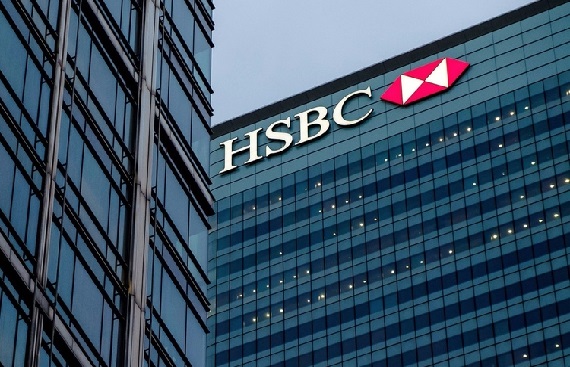
“Roaring with national pride. Soaring with global ambitions" had said billboard for HSBC Holdings Plc in December outside the fancy Mumbai region. The tiger roaming over the British bank's hexagonal red symbol on the 122-foot board was a not-so-subtle indication of the bank's intentions to rule the financial sector of what is, by some calculations, now the most populated nation in the world.
Those expansion plans are vital to shoring up growth at Europe’s largest lender, which is grappling with a downturn in profits from the Greater China region. Shanghai and Hong Kong have been the bank’s centers of gravity since opening its doors more than 150 years ago to fund trade between Europe and Asia. But as a slowing economy and crackdowns on industries from technology to real estate roil the world’s second-largest economy, HSBC is looking further afield to India — despite risks there as well.
The bank is planting its sights more firmly on the ultra-rich in India, where the wealth held by billionaires has crossed $400 billion from $148 billion in 2016. It also plans to launch an onshore private banking service in the South Asian country this year. After buying an investment business with $10.8 billion in assets under management there, it’s scouring for other selective purchases. “We certainly are always looking for bolt-ons that would help us drive our capabilities further," Surendra Rosha, co-head of Asia-Pacific at HSBC said in an interview in mid-January.
A steady stream of senior HSBC executives has flown into India over the past year. Chairman Mark Tucker met the head of India’s G20 preparation committee in December. Chief Executive Officer Noel Quinn was pictured signing a book of condolence for the late Queen Elizabeth II at the UK embassy when he was in the country in September to meet clients. The bank has seen an uptick among worldwide customers pushing into India, and the high-profile visits signal its growing interest in the country, Rosha said.
“It is a conscious effort," he said. “And I certainly think that you will see more of that in the coming years."
Quinn's visit to India saw him call on several of India's wealthiest businessmen, including Mukesh Ambani and Uday Kotak, according to a person familiar with the visit. Representatives for Ambani declined to comment, and spokespeople for Kotak didn’t respond to a request for comment.
HSBC’s bet on India — and the hurdles it must surmount to get the investments to pay off — shows the complicated decisions multinationals are being forced to make as the Chinese economic juggernaut slows. Last year, violent protests against virus lockdowns at a Foxconn factory served up a sharp reminder to international businesses like Apple Inc. of the dangers of over-reliance on individual markets.
India was a hugely attractive market, he said. “This could be a basis for a 20 to the 30-year runway for growth, as was the case for China in the 1990s."
Despite such optimism, analysts say India is riddled with its own structural problems that have the potential to limit the economy over time. Rapid growth can also mean bigger risks as executives and businesses rush to expand.
Also, despite signs of India’s growing importance, the money it makes there pales compared to what HSBC draws in Hong Kong. Four years ago, HSBC India reached a major milestone as pretax profits broke through $1 billion for the first time in more than a century on the subcontinent. Even so, that’s just 7.5% of the global total.
That leaves HSBC executives with a tough balancing act politically. Recent years have been a rollercoaster ride for HSBC and its relations with China. HSBC was criticized by Chinese media outlets for providing information to US authorities in the legal case involving Huawei Technologies’ chief financial officer, forcing the bank to publicly deny that it had “framed" the telecom giant.
HSBC also faced criticism in the West over its stance on Hong Kong’s national security law, after the bank ended up publicly backing the legislation.
India and China, which fought a war in 1962, could fight another one, said Isaac Stone Fish, founder of Strategy Risks, which specializes in corporate relationships with China. “If that happens, banks like HSBC will not want to be caught in the proverbial crossfire."
“The tensions between India and China over trade, Pakistan, and border disputes require careful handling for banks that want to maintain large presences or investments in both countries," he said.
HSBC also needs to appease its biggest shareholder — China’s Ping An Insurance Group Co., which has been pressuring the lender to consider proposals including spinning off its Asian operations. Ping An declined to comment on HSBC’s expansion outside of China.
HSBC has begun shrinking or exiting non-core operations in other territories, including its Canadian retail network. It’s expanding in places like Singapore where many of China’s super-rich are parking their money. It agreed in 2021 to buy AXA Singapore, an insurance business, for $575 million. But the size of the city state pales compared with India’s more than 1.4 billion people.
HSBC already facilitates around 8% of India’s exports, 10% of foreign direct investment, and 10% of local currency trading. Back in 1987 HSBC even installed India’s first ATM.
It still faces international competitors like Standard Chartered Plc there. Also, established major banks like Kotak Mahindra Bank, and public sector institutions like the State Bank of India still have an effective lock on much of India’s domestic banking business.