Free Trade Agreement Between India and EU Nears Finalisation
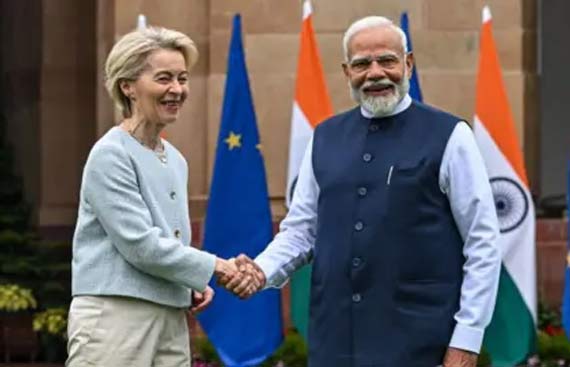
India and the EU are set to finalise a landmark free trade agreement that will strengthen economic ties, enhance investments, and foster cooperation in trade, technology, defence, and global market stability.
India and the European Union are set to finalise a long-pending free trade agreement (FTA) by the end of the year, marking a significant step in strengthening bilateral ties. The deal is expected to enhance trade, technology, connectivity and defence cooperation, reflecting a shared commitment to deepening economic and strategic partnerships. The recent meeting between Indian Prime Minister Narendra Modi and the European Commission President Ursula von der Leyen reaffirmed the commitment to concluding the deal, with both sides working towards accelerating negotiations.
The FTA is anticipated to be one of the most significant agreements of its kind, expanding market access and reducing trade barriers between India and the EU. The European Union is India's largest trading partner, surpassing both the United States and China, so the deal carries substantial economic implications. In 2023-24, trade between India and the EU exceeded $130 billion, representing a nearly 90 per cent increase over the past decade. The agreement is expected to enhance economic exchanges further and foster long-term growth.
Brussels is intensifying efforts to complete the agreement amid growing global trade trends. With potential U.S. tariffs on European goods, strengthening trade relations with India allows the EU to diversify its economic engagements. The agreement is also a strategic response to shifting global trade policies, providing financial stability and market opportunities for India and the EU.
Ongoing discussions on the FTA have addressed several complex trade issues. Negotiations, relaunched in 2021, have encountered challenges regarding market access for specific products, including automobiles and alcoholic beverages. The upcoming round of talks in March aims to resolve these concerns and bring both parties closer to a final agreement.
Beyond trade, India and the EU cooperate closely in foreign policy, security, and technological advancements. With over 6,000 European companies operating in India, there is a strong foundation for industrial collaboration and investment. Strengthening ties through the FTA will encourage further investment in key pharmaceuticals, machinery, and manufacturing sectors.
India’s trade relations with Europe have expanded in recent years. In addition to the ongoing FTA discussions with the EU, India signed a trade agreement in the previous years with the European Free Trade Association (EFTA), comprising Iceland, Liechtenstein, Norway, and Switzerland. This agreement includes a commitment of $100 billion in investments across various industries, reinforcing India’s position as a key global trade partner.
The deepening of India-EU relations holds significant economic and geopolitical importance. With both sides seeking to capitalise on emerging opportunities, the FTA is expected to enhance business collaborations and streamline regulatory frameworks. The evolving trade landscape necessitates proactive engagement, and this agreement is positioned to unlock new growth avenues for businesses in both regions.
As negotiations progress, the successful conclusion of the FTA will mark a new chapter in India-EU relations, fostering economic resilience and connectivity. The collaboration is set to drive innovation, create employment opportunities, and strengthen global supply chains, ensuring long-term benefits for businesses and consumers. The growing strategic alignment between India and the EU positions the partnership as a key driver of international trade and economic progress in the years to come.