EU and India Join Hands to Fight Marine Pollution and Develop Hydrogen Technology
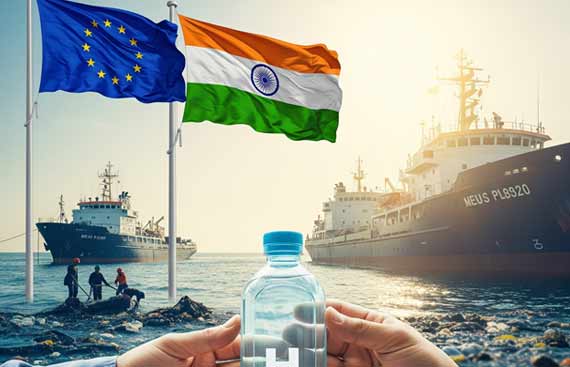
The European Union and India have initiated two major joint research and innovation programmes to address marine pollution and advance waste-to-renewable hydrogen technologies. These initiatives have been launched under the EU-India Trade and Technology Council (TTC) and represent a combined investment of €41 million. The TTC is a high-level platform to strengthen bilateral trade, technology, and innovation cooperation.
These collaborative projects are supported under the EU’s Horizon Europe programme and co-funded by India’s Ministry of Earth Sciences (MoES) and the Ministry of New and Renewable Energy (MNRE). The goal is to bring together researchers, start-ups, and industries from both regions to develop sustainable and scalable solutions with a broad global impact.
The first initiative focuses on tackling marine pollution, with special attention to marine plastic litter. This project is supported by €12 million from the EU and around ₹90 crore (approximately €9.3 million) from MoES. The research aims to develop innovative methods to monitor, evaluate, and reduce the impacts of pollutants such as microplastics, heavy metals, and persistent organic pollutants. The outcomes are expected to contribute to international environmental goals, including the UN Decade of Ocean Science for Sustainable Development. The project also aligns with the EU’s Zero Pollution Action Plan and India’s National Marine Litter Policy.
Efforts are being made to ensure that the initiative protects marine ecosystems while promoting sustainable growth. This research call follows earlier collaborative actions, such as a workshop on electric vehicle charging standards in February and a matchmaking initiative connecting EU and Indian start-ups with potential investors and partners.
The second project targets the development of waste-to-renewable hydrogen technologies. Given hydrogen’s role in the global clean energy transition, this area has become a strategic point of interest for India and the EU. The hydrogen research initiative is backed by €10 million from the EU and approximately ₹90 crore (around €9.3 million) from MNRE. The primary goal is to create efficient, cost-effective, eco-friendly hydrogen production methods to support energy security and help meet long-term climate objectives.
Additional joint research opportunities are being planned for 2026. These include potential projects on electric vehicle battery recycling and wastewater treatment. These upcoming and current initiatives are expected to bring the total investment under the TTC framework to around €60 million.
The EU-India TTC was established following a joint announcement by European Commission President Ursula von der Leyen and Indian Prime Minister Narendra Modi in April 2022. It officially launched in February 2023, with the first ministerial meeting in May 2023. As the EU’s second such platform after the EU-US TTC, this council reflects a growing strategic and economic partnership between the EU and India. Their long-standing collaboration in research and innovation dates back to the 2001 Agreement on Scientific and Technological Cooperation, which was renewed in 2020.