

CSIR's Indigenously Developed Paracetamol Unveiled by Dr. Jitendra Singh
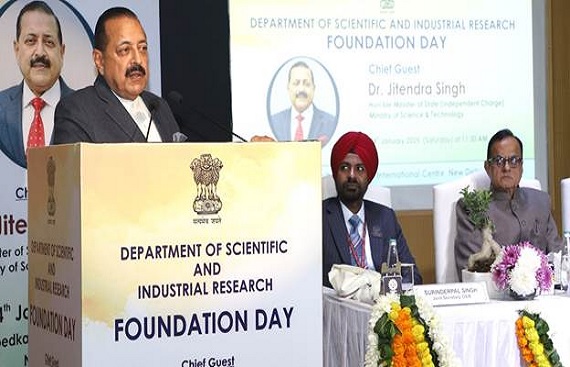
The Department of Scientific and Industrial Research (DSIR) celebrated its 40th Foundation Day at the Dr. Ambedkar International Centre, marking a momentous occasion for India’s scientific and industrial advancements. Union Minister Dr. Jitendra Singh, Minister of State (Independent Charge) for Science and Technology, Earth Sciences, and other portfolios, addressed the gathering, highlighting the nation’s significant strides in research and innovation under DSIR and the Council of Scientific and Industrial Research (CSIR).
During the event, Dr. Singh announced the development of an indigenous technology for manufacturing paracetamol, a widely used drug for pain relief and fever reduction. Developed by CSIR, this breakthrough aligns with Prime Minister Narendra Modi's 'Atmanirbhar Bharat' vision, aiming to make India self-reliant in pharmaceutical production. By reducing dependence on imported raw materials, this innovation is set to bolster domestic manufacturing capabilities. Karnataka-based Satya Deeptha Pharmaceuticals Ltd will utilize the technology to produce affordable paracetamol, ensuring its availability to consumers at competitive prices.
The Foundation Day celebration also saw the transfer of 16 new technologies, nine from CSIR-CSIO Chennai and six from CSIR-CEERI Pilani, under the “100 Days 100 Technologies” campaign. These innovations include advancements in IoT-enabled industrial instruments and healthcare technologies, further promoting the synergy between research institutions and industry. With these transfers, a total of 57 technologies have been shared with MSME units registered with LAGHU UDYOG BHARATI, an organization representing over 60,000 MSMEs across the country. Additionally, a Memorandum of Understanding (MoU) was signed between CSIR-CSIO and ELCIA (Electronics City Industries Association), Bengaluru, for collaborative sensor development.
Dr. Singh reflected on the contributions of DSIR over the past four decades and the history of CSIR as a pioneering organization in India’s scientific and industrial progress. He emphasized the importance of fostering collaborations between government, industry, and non-government sectors to scale up innovation. He highlighted the success of initiatives such as 'One Week One Theme' (OWOT) and 'One Week One Lab' (OWOL), which were introduced to streamline research efforts and promote resource sharing.
The minister underscored the significant progress India has made in technological prowess, attributing it to the visionary leadership of Prime Minister Narendra Modi. He praised the government’s initiatives since 2014 that have prioritized innovation and entrepreneurship, breaking traditional barriers to collaboration. The success in the space sector, including startups launching satellites from Sriharikota, was cited as a testament to this shift. He also acknowledged ISRO’s recent SPADEX (Space Docking Exercise) mission, which established India as one of the few nations to achieve this advanced capability.
Dr. Singh recalled several key achievements in science and technology, including the development of India’s first indigenously produced antibiotic, Nafithromycin, and the successful trial of gene therapy for treating hemophilia. He also commended CSIR’s efforts in developing innovations like the 108-petal lotus, hydrogen-powered buses, biofuels, and the Aroma Mission, which promoted lavender cultivation and gained recognition during the Republic Day celebrations.
The minister urged the scientific community to explore non-government funding and strengthen knowledge partnerships to sustain the momentum of innovation. He highlighted the Anusandhan NRF initiative, where 60% of funds are raised from non-government sectors, as a step in this direction. Reaffirming the government’s commitment to science and technology, he assured the audience that 2025 would witness even greater advancements in the field.
Dr. N. Kalaiselvi, Secretary of DSIR and Director General of CSIR, recalled the signing of the Guwahati Science Declaration, which aims to position India as a global economic hub by 2047. Prof. A.K. Sood, Principal Scientific Advisor to the Government of India, emphasized the need for India to transition from a service economy to a product-based economy driven by indigenous designs and technology. He highlighted the role of technology in contributing significantly to economic growth, drawing parallels with the U.S., where 9% of GDP is derived from the tech sector.
The event was attended by senior scientists, industry leaders, and representatives from MSMEs, who collectively celebrated the achievements of DSIR and CSIR. Dr. Singh concluded by congratulating the DSIR team on their 40th Foundation Day and reaffirmed the government’s dedication to fostering innovation for national progress.


