

Big Box India 2024: Evolving Consumer Behavior and Shopping Trends
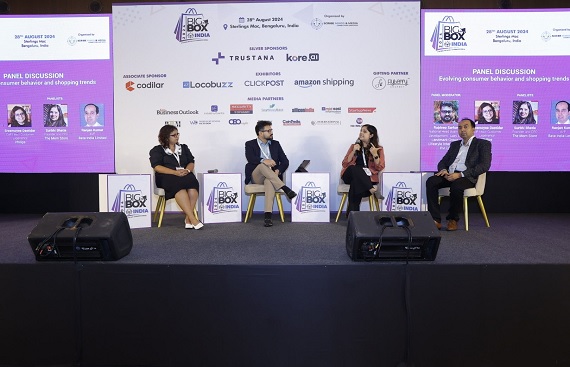
The BIGBOX 2024 INDIA is set to redefine the future of retail and e-Commerce in India, as the industry converges to explore the latest trends, challenges, and opportunities. With India's retail market projected to reach $1.1 trillion by 2027, this summit gathers visionaries, innovators, and key stakeholders to discuss critical topics like omnichannel retailing, digital transformation, supply chain optimization, and consumer behavior. Featuring insightful presentations, panel discussions, and unparalleled networking opportunities, BIGBOX 2024 INDIA is the must-attend event for anyone looking to thrive in the rapidly evolving retail and e-Commerce landscape.
The opening panel discussion, ‘Evolving Consumer Behavior and Shopping Trends’, offered deep insights into how shifting consumer demands are reshaping retail strategies. Rajdeep Sarkar, Assistant Vice President & National Head of Business Development at Landmark Group-Easybuy, moderated the discussion, which featured Surbhi Bhatia, Founder and CEO of The Mom Store; Ranjan Kumar, AVP at Bata India Limited; and Sreemoyee Dastidar, Voice of Customer Lead at Philips. Bhatia emphasized the significant shift in consumer behavior, driven by the demands for availability, accessibility, and awareness."Today’s consumers have fundamentally altered retail dynamics", she noted, with the rise of digital media and e-Commerce turning shopping into a more spontaneous experience. This evolution has leveled the playing field, allowing smaller brands to compete effectively with larger ones.
Dastidar echoed this sentiment, stating that "e-Commerce has profoundly changed consumer behavior by making shopping more convenient and price-sensitive", which has led to decision fatigue and the need for streamlined, user-friendly online experiences. Ranjan Kumar addressed the growing trend of conscious consumerism, pointing out that "sustainability and ethical practices have become crucial in product development and supply chain management". He highlighted the challenge of balancing affordability with ethical production practices to meet the increasing consumer demand for ethical shopping.
The second panel discussion focused on building resilience in retail and e-Commerce. Ranjith Kumar, Head of Customer Experience, Ninjacart, moderated the discussion. Industry leaders shared strategies for thriving amidst uncertainty. Aniket Kothri, Head of O&O e-Commerce at Puma Group, discussed how Puma is adapting to the post-COVID retail landscape by leveraging its strengths in sport and performance. Kothri highlighted Puma’s investment in its Nitro franchise and the enhancement of its in-store experience with initiatives like the Endless Aisle, which allows customers to access a broader range of products. He also mentioned Puma's adoption of WhatsApp for customer communication to streamline service. Sanjay Narasimha, CM and Head of Product of Gen AI at Samsung emphasized the role of in-store innovation in driving footfall. Samsung’s approach includes creating immersive retail environments where customers can interact with products and experience their features firsthand. "Creating immersive environments not only enhances brand recall but also ensures that customers receive accurate information", Narasimha explained. Samsung’s stores, such as the Galaxy store on Brigade Road, are designed to let customers explore at their own pace, which helps build long-term brand loyalty.
The third panel discussion addressed the rise of micro-entrepreneurs in e-Commerce and was moderated by Meenakshi Vyas, Head Marketing Jiomart, Reliance Retail, exploring their transformative impact and the challenges they face. Achal Sharma, AVP Engineering at Wakefit, highlighted the significant economic impact of micro-entrepreneurs despite their limited resources. He shared insights from his experience at Myntra, noting how small businesses can scale from modest beginnings to substantial daily sales. Rakhi Rana, COO & Head of International Business and E-Commerce at Drools, discussed the difficulties faced by micro-entrepreneurs, particularly in Tier-II and Tier-III cities, with tech adoption and e-Commerce operations. She recommended seeking assistance from agencies specializing in product listing, content creation, and financial management.
Both Sharma and Rana agreed on the transformative impact of digital payment gateways, which enhance transaction security and accelerate cash flow, facilitating faster reinvestment and growth. Government policies such as Digital India and the Prime Minister’s Mudra Yojana (PMMY) have provided crucial financial support and incentives. Rana advised micro-entrepreneurs to leverage established marketplaces like Amazon and Flipkart before transitioning to direct-to-consumer platforms, emphasizing the importance of building a customer base and refining product offerings. Sharma concurred, stressing the need for clear business goals and a strong digital presence for long-term success.
The BIGBOX 2024 INDIA summit has not only highlighted the evolving landscape of retail and e-Commerce but also provided valuable insights into how businesses can adapt and thrive in this dynamic environment.


