A New Chapter in India-UK Relations
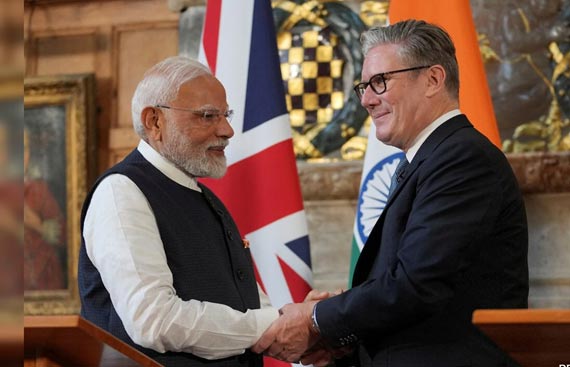
Indian Prime Minister Narendra Modi’s visit to the UK primarily aims to sign the Free Trade Agreement (FTA), while also symbolising the culmination of efforts to strengthen bilateral relations. A more mature, multi-dimensional partnership is emerging—one that moves beyond the traditional bonds of shared language, legal frameworks, and the so-called ‘living bridge’ of the Indian diaspora.
From Trade to Strategic Engagement
The signing of the FTA—formally the Comprehensive Economic and Trade Agreement—paves the way for ratification and implementation, a process that could take up to a year.
For India, the benefits are substantial. 99 per cent of Indian exports to the UK will face zero tariffs. Critically, India’s politically sensitive agricultural sector, which employs over 40 per cent of the workforce, has been excluded from the agreement, shielding it from UK competition.
New Delhi also secured favourable terms through a separate Double Contribution Convention Agreement. This allows Indian professionals temporarily working in the UK to avoid national insurance contributions for three years—a reciprocal arrangement that applies equally to British workers seconded to India.
The UK also gains significant advantages. Average Indian tariffs on British goods will fall from 15 per cent to 3 per cent. Tariffs on key UK exports—including automobiles (cut from 100 per cent to 10 per cent) and alcoholic beverages such as whisky and gin (reduced from 150 per cent to 75 per cent, and eventually to 40 per cent)—will be substantially lowered. British firms will also gain access to India’s substantial government procurement market. The tariff reductions are estimated to be worth £400 million initially, rising to £900 million within a decade.
The UK currently hosts nearly 1,000 Indian companies, collectively employing over 100,000 people. The deal is projected to generate over 2,200 new jobs in the UK and boost annual British wages by £2.2 billion.
Arguably, the agreement holds greater strategic and economic importance for the UK than for India. Prime Minister Keir Starmer has called it “the biggest and most economically significant trade deal that the UK has made since leaving the EU.” While the UK has signed several trade deals post-Brexit, India—now the world’s fastest-growing major economy—offers the most promising opportunity.
By contrast, India is engaged in negotiations with more influential trade partners, such as the EU and the US. As a result, the political value of the UK deal is more limited. Still, the agreement may serve as leverage for India in those concurrent negotiations.
Given India's relatively protectionist stance, the FTA’s reduction of tariffs and non-tariff barriers is likely to benefit the UK more significantly. Current projections estimate a 0.13 per cent GDP boost for the UK, compared to 0.06 per cent for India. UK exports to India are expected to rise by nearly 60 per cent, while imports from India will grow by 25 per cent. Bilateral trade is forecast to increase by 39 per cent, reaching £25.5 billion by 2040.
Towards a New Strategic Mindset
To realise the full potential of the partnership, both sides must recalibrate their foreign policy approach. The UK should recognise and invest in this distinctive positioning, leveraging its status as a global financial and fintech hub to support India’s development goals, particularly in the Global South. This could include initiatives in education, public health, and digital infrastructure.
Both nations also stand to benefit from enhanced cooperation with like-minded countries, including the US, France, and Australia, on shared priorities such as Indian Ocean security and climate change. This could take the form of trilateral or minilateral groupings, or an expansion of existing forums, such as the Quad. UK participation in the Quad, for example, would be a significant step toward the “genuine strategic partnership” envisioned in the UK’s national strategy.
India’s longstanding commitment to strategic autonomy—reflected in its close ties with countries such as Russia and Iran—complicates cooperation in sensitive areas, including intelligence sharing and advanced technology transfers. Addressing these complexities will require sustained effort and a gradual building of trust over time.