

Why Most Investors Lose Money In Small-Cap Funds

Investing in small cap mutual funds can be highly rewarding, but it also comes with significant risks. These funds invest in companies with small market capitalisation, which have high growth potential but are also more volatile than large and mid cap mutual funds.
Many investors are attracted to small-cap funds because of their potential for high returns. However, most end up losing money due to market fluctuations, poor investment timing, and lack of knowledge about how these funds work. Unlike mid cap mutual funds, which offer a balance between risk and reward, small-cap funds require careful selection and a long-term approach.
This guide explains why investors often lose money in small-cap funds, the risks involved, and how to avoid common pitfalls. Understanding these aspects can help investors make better financial decisions and improve their chances of success in the stock market.
What are small-cap mutual funds
Small cap mutual funds invest in companies ranked below the top 250 listed firms in India based on market capitalisation. These businesses are usually in their growth stage and have the potential to generate high returns over time.
Unlike mid cap mutual funds, which invest in relatively stable companies, small-cap funds are more volatile. Their performance depends on market trends, company fundamentals, and economic conditions.
These funds are suitable for aggressive investors who can tolerate market fluctuations and have a long-term investment horizon. However, they require careful analysis and patience, as short-term volatility can lead to losses.
Common reasons why investors lose money in small-cap funds
1. Lack of patience
Small-cap stocks take time to grow. Many investors exit too early, missing out on potential gains.
2. Wrong investment timing
Investing when markets are overheated increases the risk of losses when corrections happen.
3. Not understanding volatility
Small-cap stocks fluctuate more than mid cap mutual funds, leading to panic selling during market downturns.
4. Poor fund selection
Choosing a fund without analysing its past performance, fund manager expertise, and portfolio quality can result in losses.
5. Inadequate diversification
Investing only in small-cap funds without balancing with large or mid cap mutual funds increases portfolio risk.
6. Ignoring fund expenses
Higher expense ratios in small-cap funds can reduce net returns, affecting overall profits.
Volatility and risk factors in small-cap funds
Small-cap funds are highly sensitive to market movements, making them riskier than mid cap mutual funds. Key risk factors include:
1. Market risk
Economic downturns, inflation, and global events impact small-cap stocks more than larger companies.
2. Liquidity risk
Selling small-cap stocks can be challenging due to lower trading volumes, especially during market crashes.
3. Business risk
Small companies often face challenges like limited resources, high debt, and operational inefficiencies, which can affect their growth.
4. Regulatory risks
Policy changes, tax regulations, and compliance issues can impact small-cap companies more than established firms.
Understanding these risks helps investors make informed decisions while investing in small cap mutual funds.
Small-cap vs mid-cap mutual funds
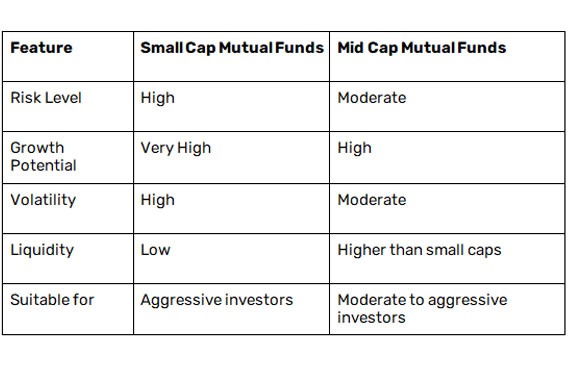
While small cap mutual funds offer higher growth potential, mid cap mutual funds provide a balance between risk and reward. Diversifying across both categories can help investors manage risks better.
Expert strategies to reduce losses in small-cap funds
To minimise losses and maximise gains, investors should follow these expert strategies:
1. Invest for the long term
Small-cap funds require at least 7-10 years to show significant returns. Avoid short-term trading in these funds.
2. Enter during market corrections
Investing when markets are down can provide better entry points and higher returns over time.
3. Diversify your portfolio
Balancing small-cap funds with mid cap mutual funds and large-cap funds helps reduce overall portfolio risk.
4. Choose funds with strong track records
Invest in funds managed by experienced professionals with a proven history of handling small-cap volatility.
5. Review performance regularly
Monitor your investments and rebalance your portfolio if a fund underperforms consistently.
6. Use systematic investment plans (SIP)
Investing through SIPs reduces the impact of market volatility and ensures disciplined investing.
Applying these strategies can help investors achieve better results while managing risks effectively.
Taxation on small-cap mutual funds
The taxation of small cap mutual funds is the same as mid cap mutual funds and other equity-oriented schemes:
- Short-term capital gains (STCG) – Gains from investments held for less than one year are taxed at 20%.
-
Long-term capital gains (LTCG) – Gains above
 1.25 lakh from investments held for over one year are taxed at 12.5% without indexation benefits.
Being aware of tax implications helps investors plan their investments efficiently and maximise post-tax returns.
Mistakes to avoid when investing in small-cap funds
Investors should avoid the following common mistakes to reduce losses in small cap mutual funds:
1. Chasing past returns
Past performance does not guarantee future returns. Always analyse current market conditions before investing.
2. Investing without research
Blindly following trends or recommendations without analysing the fund’s fundamentals can lead to poor investment choices.
3. Withdrawing investments in panic
Market downturns are normal. Exiting investments due to fear can result in losses.
4. Ignoring expense ratios
High expense ratios can eat into returns. Always compare costs before investing.
5. Not setting financial goals
Investing without clear goals can lead to poor decisions and suboptimal returns.
Avoiding these mistakes can improve the chances of making profits in small cap mutual funds.
Best small-cap investment approach
For the best results, investors should follow a disciplined investment approach:
- Set clear financial goals – Define your investment purpose, such as wealth creation or retirement planning.
- Allocate funds wisely – Invest only a portion of your portfolio in small-cap funds to balance risk.
- Monitor fund performance – Regularly track your investments and switch funds if necessary.
- Stay invested for the long term – Patience is key to achieving high returns in small-cap funds.
- Seek expert advice – Consult financial experts if unsure about fund selection or market trends.
Following these steps ensures a better investment experience with small cap mutual funds.
Conclusion
Small cap mutual funds offer high growth potential but come with significant risks. Many investors lose money due to impatience, poor timing, and lack of knowledge. Unlike mid cap mutual funds, which provide moderate risk and stable returns, small-cap funds require a long-term commitment and strategic investing.
By following expert strategies, avoiding common mistakes, and maintaining a diversified portfolio, investors can reduce losses and improve returns. A well-researched investment approach ensures financial growth while managing market risks effectively.


