

Top Takeaways from GCCs Pioneers in 2025

- GCCs are driving AI fintech automotive and healthcare breakthroughs
- GCCs are investing in generative and agentic AI with dedicated innovation teams
- GCCs contribute 0.5 trillion GVA employ millions and set global benchmarks
As 2025 concludes, India's Global Capability Centers (GCCs) have solidified their role as engines of innovation and economic momentum. Once viewed primarily as cost-saving back offices, these centers now drive cutting-edge advancements in AI, digital transformation, and sustainable growth.
With over 1,700 active GCCs contributing an estimated $182 billion in gross value added (GVA) to the economy in FY25 surpassing the GVA of 25 Indian states and union territories the sector has grown robustly. Projections indicate the market size could reach $90 billion by year-end, on track to hit $100-110 billion by 2030, with the number of centers expanding to 2,400-2,500.
The Rise of Strategic GCCs in India

GCCs in India have transitioned from operational support to strategic innovation powerhouses, influencing sectors from automotive to fintech.
Sandeep Kumar Jain, Managing Director, CDK Global India, echoes, "India’s Global Capability Centers (GCCs) are no longer just extensions of multinational firms, they have become India’s own innovation playgrounds. In sectors such as automotive and retail, they are driving breakthroughs in autonomous driving, hydrogen fuel, AI-led shopping, and even quantum computing. Their uniqueness lies not only in cost efficiency but also in their ability to reduce time-to-market, accelerate prototyping, and reimagine customer experiences. Positioned at the intersection of talent, technology, and transformation, India’s GCCs are setting tomorrow’s global standards today".
This sentiment aligns with broader trends, 70% of GCCs now prioritize R&D and product development, shifting from back-office tasks to high-impact initiatives. Cities like Bengaluru, Hyderabad, and Pune host thriving ecosystems, attracting global firms.
Bhavna Jagtiani, CEO of Edelman India, said that GCCs are driving digital transformation and innovation across industries like fintech, biotech, energy, and retail. “We’ve been partnering with GCCs to shape their brand reputation, attract the right talent, and highlight their impact. This new service brings together our cross-functional expertise to support their growth journey”, she added.
The BFSI sector leads with innovation in core banking, regtech, and digital finance, while manufacturing and healthcare leverage GCCs for AI-optimized supply chains and personalized medicine.
GCCs in 2025 Redefining Enterprise with AI

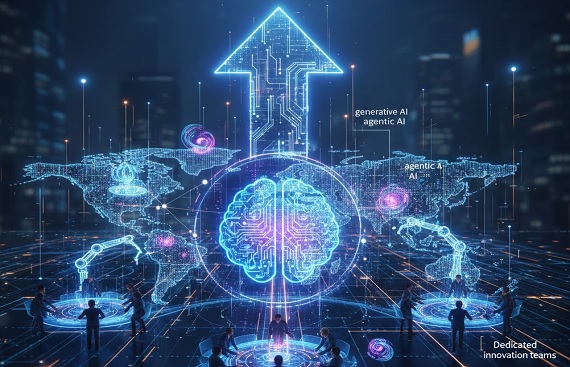
Artificial intelligence has been a cornerstone of GCC evolution in 2025, with 83% investing in generative AI and 58% in agentic AI, up from previous years. Two-thirds have created dedicated innovation teams to globalize ideas, focusing on pilots that rose from 37% to 43%.
Biddappa Muthappa, Co-Founder & CEO, Sash.Ai, highlighrts "As AI takes on more cognitive functions, GCC leaders must evolve beyond traditional management skills and embrace new leadership capabilities that balance machine-driven efficiency with distinctly human strengths. Every leader must develop at least a high-level understanding of AI’s architecture, opportunities, and limitations. This knowledge is essential to navigate trade-offs, make informed decisions, and engage confidently in AI-driven transformation".
This focus extends to ethical AI, reskilling, and trust-building, as noted in recent reports on mega GCCs driving AI-led transformation for enterprise agility. AI applications in audit trails, HR augmentation, and boardroom analytics are becoming standard, with digital-first approaches accelerating growth.
Mohan Subrahmanya, Country Leader & Executive Director - India, Insight Enterprises, says, "Global Capability Centers (GCCs) are increasingly driving product innovation, AI development, and enterprise-wide transformation, positioning the country as the ‘brain’ rather than the ‘back office’ of global operations".
Also Read: How GCCs Are Quietly Powering Global Tech Strategy
Redefining India’s Economic Growth
India's GCCs are poised to contribute $0.5 trillion in GVA as the nation targets a $10 trillion economy, directly employing 20-25 million people in the next decade.
Gunjan Samdani, Co-Chairman of Goldman Sachs India, said at the CII GCC Summit held, "India's Global Capability Centers (GCCs) are set to become a key pillar of the nation's economic growth, with the potential to contribute $0.5 trillion in gross value added as the country moves toward becoming a $10 trillion economy".
Hosting over 50% of the world's GCCs, India has transformed its $46 billion market into an innovation engine employing 1.7 million professionals.
Samina Sheriff, IT Director, Providence says, "India's pioneering role in the GCC ecosystem has set the benchmark for other emerging markets. Hosting over 50% of the world's Global Capability Centers, the country has transformed its $46 billion GCC market into a robust innovation engine employing 1.7 million professionals. Cities like Hyderabad and Pune have evolved beyond being mere operational hubs to become thriving innovation centers, attracting global organizations across sectors. This success has created a blueprint for other emerging markets to follow, while simultaneously raising the bar for innovation and operational excellence".
Even amid global policy shifts like H1-B visa changes, impact remains minimal, with domestic talent pools sustaining growth. The CII GCC Summit highlighted policy needs, including a national framework for digital economic zones and industry-academia ties to boost GDP contribution to $470-600 billion by FY30.
While India's GCC narrative dominates, regional expertise informs global strategies. Leon Smith, Managing Director, GCC Solutions, emphasizes, "Well acquainted with the legal regulations & business policies of UAE and Gulf countries, GCC offers a suite of services spanning from legal structuring, company incorporation to corporate nominee sponsorship. Its expertise in contriving strategic solutions enables clients to seamlessly carry forward their company formation plans in UAE, Saudi Arabia, Kuwait, Oman & Bahrain".
This cross-regional perspective underscores how India's GCCs can learn from Gulf models for compliance and expansion, fostering partnerships in emerging markets.
Wrapping It Up!
In 2025, India's GCC pioneers have not only adapted to challenges but pioneered solutions, from AI ethics to sustainable scaling. As Oliver Wyman notes, these centers now innovate core business functions, positioning India as a global epicenter.
Looking ahead, collaboration on talent, policy, and tech will ensure sustained impact, turning ambitions into a legacy of inclusive prosperity.


