Sony Ericsson unveils Satio 12.1 megapixel cameraphone
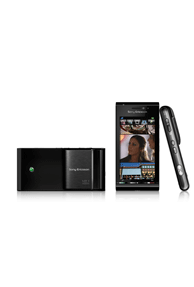
Bangalore: Business has never been harder for touchscreen mobile phones. Not only is the iPhone 3GS so far ahead it's little more than a speck on a distant horizon, but HTC has the geek market neatly sewn up with its Android-based Hero. Even the Palm Pre failed to tickle our collective fancies, and 53 percent of current touchscreen owners will be getting a phone with buttons next time around, if market watcher Canalys is to be believed.
What chance, then, does Sony Ericsson's Satio have? Or has the manufacturer discovered Apple's secret formula? The Satio's main feature is the 12.1 megapixel camera, which is activated by sliding back the lens cover. It takes gigantic images. At 4000 x 3000 you could, in theory, print the Satio's pictures at 33cm wide at 300dpi.
The Satio's screen is a 3.5 inch, 360 x 640 touchscreen. It's resistive rather than capacitive, so bang go clever multi-touch features such as pinching to zoom into Google Maps or into your images. If your Satio doesn't come with iPlayer installed, you can get it - the Satio runs a heavily-skinned and touchscreen-optimised version of Symbian Foundation, the newly open-source incarnation of what was Nokia's S60 platform.
The operating system works well. Inevitably, it's disappointing compared to current touchscreen champs such as the iPhone, Hero and Pre. The full-screen Qwerty keyboard, which looks so useful on paper, is actually very difficult to type accurately on. The keys are only about seven millimeter wide, and there's no on-board dictionary to help guess what you were trying to type.
Unfortunately, a phone's success depends on how well its hardware matches its software, and although the Satio's implementation of Symbian is far from disastrous, the phone's hardware isn't exactly very good. For a start, there's the thickness. The Satio's spec sheet claims the phone is 1.12cm thick, but that's at the thinnest point. Measured at the bulky lens cover on the back the Satio is nearly 2cm thick.
The rest of the Satio's feature list ticks most of the right boxes. Call quality is excellent, for instance, and all the connectivity you could want from a top-end phone is here. Assisted-GPS is accessed from the the pre-installed Google Maps, and data access comes courtesy of either the integrated Wi-Fi or 3G radios. The Satio does quad-band GSM/GPRS/Edge, but it's limited to the 900MHz and 2100MHz bands for HSDPA 3G/WCDMA.
Battery life is good too: we made a few calls, watched iPlayer and used Google Maps extensively, and the Satio's battery indicator headed into the red slightly over 24 hours after the charger is disconnected. The chief irritation is the proprietary data/charger/headphone connector - lose the USB cable and you're stuffed. The headphone connector has an integrated microphone, at least, and terminates in a 3.5mm headphone jack so you can connect your own 'phones.
The device is a direct competition to the likes of the Nokia N97 and the Omnia HD all of which share the same OS platform The phone comes with 128MB of onboard memory and supports microSD cards of upto 32GB. The Satio has been priced at  35,950 - which is on par with the prices of Nokia N97 and the Omnia HD.
35,950 - which is on par with the prices of Nokia N97 and the Omnia HD.