Why Banks Are Spending Billions on Quantum-Safe Encryption

- Quantum computers can break today’s encryption, putting bank data and transactions at risk.
- Banks are adopting quantum-safe cryptography and agile systems to secure core operations.
- Compliance mandates and operational risks are driving billions in security upgrades.
In the quiet chambers of global finance, a takeover is underway driven not by crashes or reforms, but by quantum time itself. Banks are pouring billions into re-locking their digital vaults, rewriting the code beneath every transaction and identity.
This is not caution, it is survival. With attackers already banking encrypted secrets for future unraveling, the race is on to outpace a machine that could unmake trust in minutes. Tomorrow’s money is being defended today.
Sunil Gupta, Co-founder & CEO, QNu Labs says, “Quantum computers are no longer a distant threat but an imminent reality and once they mature, they will break today’s classical encryption in seconds, leaving no data, whether at rest or in motion, safe”.
How Quantum Is Rewriting Banking’s Fate
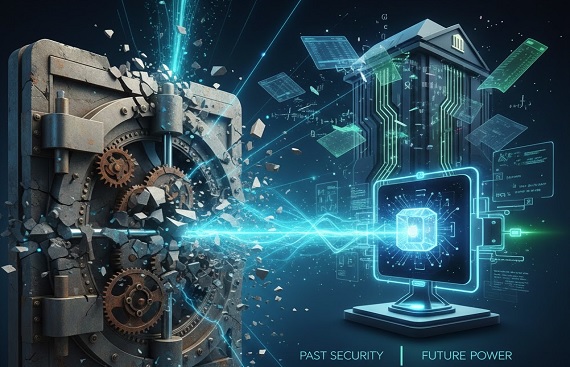
The urgency facing banks today is born from a dangerous imbalance between past security and future power. The encryption systems that protect financial life built on puzzles like prime factorization and complex number problems were designed for machines that think step by step.
Quantum computers think in waves. Using qubits that exist in many states at once, they collapse problems that once took centuries into hours. A single breakthrough could expose hidden transactions, aging account records, and financial histories once believed untouchable. And this isn’t fear-mongering. Intelligence communities already warn that encrypted data is being quietly collected, stored, and prepared for future quantum decoding.
For banks, one successful quantum breach could mean frozen markets, shattered confidence, and regulatory chaos. That is why institutions are rebuilding security from the inside outadopting post-quantum systems, redesigning infrastructure, and retraining people. This is not an upgrade cycle. It is a survival rewrite, where delaying today could damage trust forever.
The Day Encryption Changed Forever

At the heart of this transformation lies a cryptographic overhaul, swapping vulnerable standards for quantum-resistant fortresses. No longer content with band-aids, banks are embedding post-quantum cryptography (PQC) into core systems, prioritizing hybrid schemes that layer classical and quantum-safe methods for seamless transitions.
Lattice-based encryption, for example, draws on the hardness of shortest-vector problems in high-dimensional grids mathematical mazes quantum machines struggle to navigate. Kyber, a NIST-vetted candidate, exemplifies this, it's lightweight enough for real-time mobile banking yet robust against Grover's search speedup, which halves classical security but leaves lattice puzzles intact.
Implementation demands more than code swaps. Banks are architecting ‘crypto-agile’ platforms modular infrastructures that allow algorithm rotations without downtime. Picture a core banking system where encryption keys live in isolated hardware security modules (HSMs), updated via over-the-air protocols. This agility proves vital amid evolving threats, as quantum error rates drop, banks can pivot from CRYSTALS-Dilithium signatures to emerging alternatives without halting operations.
The cost? Eye-watering. A mid-sized institution might shell out $500 million over five years for audits, retraining, and hardware refreshes, per industry benchmarks from quantum risk consultancies.
Regulatory tailwinds accelerate the rush. Frameworks like the EU's Digital Operational Resilience Act (DORA) mandate quantum-readiness assessments by 2025, tying compliance to operational continuity.
Similarly, NIST's PQC standardization finalized in 2024 with FIPS 203-205 sets a global benchmark, pressuring banks to certify systems or face audits that could spike capital reserves. Non-compliance isn't abstract, it invites penalties scaling to 2% of global turnover under GDPR, plus the specter of class-action suits in a post-breach world.
Jose Thattil, Co-Founder & CEO, Phi Commerce, echoes, "PCI DSS compliance, data encryption of sensitive payment data, real time fraud detection are core features of a secure Payment Gateway".
Also Read: How UPI is Draining Holiday Wallets with 'Buy Now, Pay Later' Loans
Real-World Ripples and the Quantum-Secured Horizon
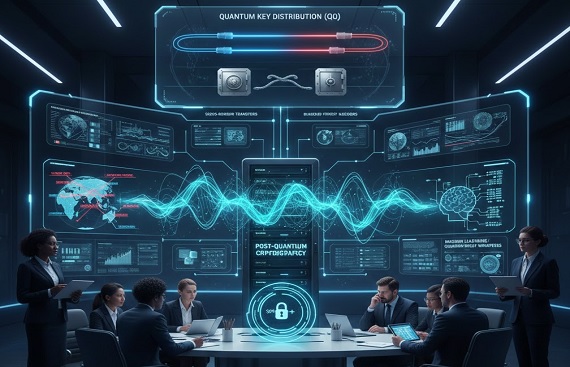
The re-encryption imperative ripples far beyond server farms, reshaping banking's operational DNA. Secure payments, once bottlenecked by legacy ciphers, now leverage PQC to fortify tokenization in real-time fraud detection. Machine learning models, trained on anonymized transaction graphs, gain quantum-proof wrappers, ensuring predictive analytics remain uncrackable even as data volumes explode.
Operations streamline too, automated key management reduces human error, while blockchain ledgers prime targets for quantum forgery adopt hash-based signatures like SPHINCS+ for immutable audit trails.
Yet, the journey exposes vulnerabilities in the supply chain. Legacy vendors lag, forcing banks to co-develop PQC toolkits or migrate to open-source stacks like OpenQuantumSafe. Interoperability challenges abound cross-border transfers demand synchronized upgrades, lest a weak link invite exploits.
And talent? A dearth of quantum-literate cryptographers inflates hiring costs, with roles commanding premiums in a field where PhDs in algebraic geometry are the new MBAs.
Looking ahead, this scramble heralds a fortified financial ecosystem. Quantum key distribution (QKD), channeling photons for tamper-evident key exchanges, pairs with PQC to create ‘information-theoretic’ security unbreakable even by godlike quantum adversaries. Early adopters report ancillary wins, enhanced data sovereignty aids GDPR compliance, while resilient encryption bolsters DeFi integrations, blending traditional vaults with crypto-native ledgers.
Nitin Bhatnagar, Associate Director, PCI Security Standards Council, highlights, “Indian business owners must realise that implementing new payment methods must be complemented with the appropriate security standards. Without the standards, sooner or later a data breach is almost inevitable. Hackers are constantly probing businesses for security weaknesses, and as soon as they find one without safeguards, they will infiltrate its computer systems and steal customer payment data for profit”.
Winding It Up!
Banks' quantum re-encryption isn't a line item it's a reinvention. By investing now, they don't just safeguard archives, they pioneer a trust architecture for an era where computation defies classical limits.